
United States / 1957 / DISPUTED
Levelland UFO case
The Levelland case is a documented cluster of reports from roads around Hockley County during the wet, low-cloud night of 2-3 November 1957. Motorists described lights or luminous forms in different colors, shapes, durations and positions; several attributed temporary engine, headlight or radio failures to the nearby light. The strongest surviving account is an Air Intelligence interview with a 19-year-old Texas Tech student: his ammeter discharged and his engine, lights and radio failed before he saw an oval light; after four or five minutes the light rose and his car restarted. Separate law-enforcement witnesses reported only brief red-orange streaks and did not report vehicle failure. The 1006th Air Intelligence Service Squadron checked weather, air traffic, balloons, utility lines and oil-field gas, interviewed five principal sources, and initially forwarded the matter as unresolved. Project Blue Book later classified it as ball lightning or an electrical-weather effect, while its own file contains reviewers who said ball lightning was too poorly understood to account for the details and that no single explanation was required. A mechanic documented an ordinary distributor fault in one separately publicized truck, but that finding cannot be generalized to every vehicle claim. The file contains no authenticated event photograph, radar plot, instrument measurement or physical trace. B / DISPUTED therefore reflects a substantial contemporary record with unresolved causal and counting conflicts, not evidence of extraterrestrial technology.
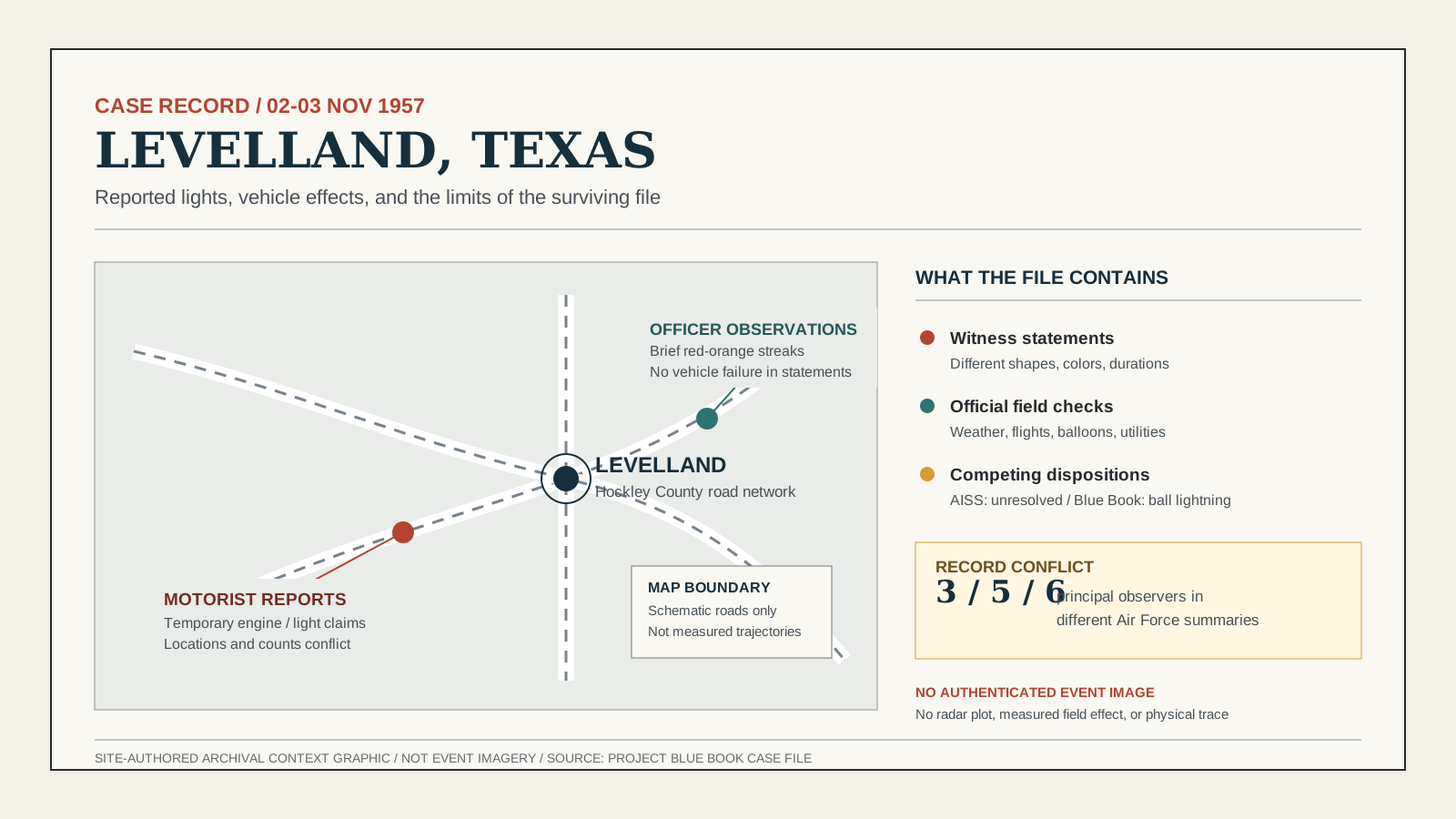
This case is disputed. The archive preserves the claims while separating evidence from interpretation.
- Documentation
- High documentation
- Primary location
- Levelland and Hockley County roads, Texas
- Source base
- 6 linked records
- Research use
- Comparison case
What the surviving record establishes
- Report window
- The main cluster occurred from late 2 November into the early hours of 3 November 1957 on roads around Levelland; the 4 November red-light report was a distinct event.[1][3]
- Vehicle claims
- Several motorists reported temporary engine, light or radio failures, but there was no instrumented test and the strongest detailed sequence began before the witness saw the light.[1]
- Officer evidence
- Two law-enforcement statements describe only split-second or two-second red-orange streaks and do not report vehicle failure; they do not independently confirm a landed oval.[1]
- Official disposition
- The AISS field report went forward as unresolved; later Blue Book analysis classified ball lightning. The same official file preserves technical objections to that mechanism.[1]
Case dossier
Levelland was an oil-and-farming community west of Lubbock, crossed by highways and farm roads where the reports were geographically dispersed. The surviving Project Blue Book packet is not one continuous witness statement. It combines phone questionnaires, Air Force messages, press clippings, six source sections in a 1006th AISS report, weather and utility checks, analytical memoranda, and later summaries. Some names were redacted in the released copy, while newspapers and later writers supplied names. The dossier therefore establishes that an official investigation occurred; it does not turn every estimate or press attribution into a measured fact.
Near 11: 00 p.m. on 2 November, farm worker Pedro Saucedo and passenger Joe Salaz were publicly identified with the first widely circulated road encounter south of Levelland. Contemporary reporting attributed to Saucedo a bright object near the road, a thunder-like sound, and a truck engine and lights that stopped and later recovered. The Air Force file repeats versions of that report, but the detailed AISS investigation says its most publicized original source could not be located for interview. Saucedo's dimensions, distance and motion are therefore witness estimates transmitted through press and official summaries, not measurements verified at the scene.
At 12: 05 a.m., about four miles west of Smyer on Texas Highway 116, a 19-year-old Texas Tech student commonly identified as Newell Wright supplied the file's most detailed vehicle sequence. He said the ammeter momentarily showed complete discharge, returned to normal, and then the engine began cutting out despite fuel. After it stopped, the lights and radio failed. He opened the hood, found no fault, closed it, turned to seek help and only then saw a white oval with a greenish tint. He estimated four to five minutes of observation before it rose out of view; afterward the lights, radio and engine worked normally. Heavy cloud and light rain were recorded. His account strongly documents what he reported, while its order leaves the cause unmeasured: the electrical symptoms preceded his sight of the light.
The official packet separates the police observations from the longer road-object stories. A 24-year-old Texas Highway Patrolman searching the Oklahoma Flats Highway reported a red-orange flash crossing the roadway at about 1:15 a.m., lasting only a fraction of a second. A 43-year-old local officer, apparently Sheriff Weir Clem, reported at about 1:30 a.m. a reddish streak moving south to west in roughly two seconds while he searched for reported objects. Neither statement records engine or headlight failure. Their participation confirms that officers joined the search and saw brief lights; it does not independently confirm a landed oval, a shared object, or the motorists' electrical claims.
Air Force and civil authorities responded quickly but did not recover an object or trace. A Reese AFB message says Provost Marshal Major Daniel R. Kester visited an alleged site with local officials and obtained negative results. Staff Sergeant Norman P. Barth of the 1006th AISS then investigated from 4 to 6 November. His 19-page report treated six source sections: one extended oval account, one internally inconsistent account, two officer light-streak reports, a nearby Air Force technician's lightning-like flash, and a distinct 4 November report. The preparing officer judged only the first account central, said the two streak reports could not be linked to it, and explicitly separated the 4 November incident.
The environmental checks were specific, though not conclusive. Reese AFB and the U.S. Weather Bureau office at Lubbock supplied a complete overcast with a 400-foot ceiling, visibility of three miles, drizzle or light rain, and a shallow temperature inversion. Astronomer Ralph S. Underwood considered St. Elmo's fire-like effects, low-cloud reflection from limited oil-field gas flares, and lightning capable of stalling a car; he also noted that repeated incidents would weaken a simple lightning explanation. Air traffic checks were negative, weather balloons were considered unlikely for the main reports, the power company found no downed line, and oil companies said only limited excess gas was being burned. These checks narrow possibilities but do not reproduce a witness sequence.
The official reasoning changed inside the file. The 1006th AISS preparing officer listed St. Elmo's fire, ball lightning, reflected gas flare or a combination, but concluded that his organization lacked enough knowledge and forwarded the sighting as unresolved. A 5 December internal reviewer went further: no two sightings were simultaneous, ordinary lightning or cloud reflection might explain some, ball lightning was not understood well enough to explain the details, and investigators needed the exact order of each vehicle failure. On 3 January 1958, Captain George T. Gregory nevertheless entered an analyst's conclusion of ball lightning, arguing that fog, rain, a 400-foot ceiling, recent lightning and moisture-laden ignition parts were compatible. His language used may and conducive; it was a model, not an experimental confirmation.
Counts expanded as publicity grew. One early Air Force message said three rather than nine people, the detailed AISS report summarized five interviewed sources plus a separate later source, a typed Blue Book summary said five, and the final record card referred to six observers. Other official pages mention a flood of up to 300 reports over roughly three days, more than 300 in five days, or about 600 over three weeks; those numbers concern the wider publicity wave, not independent Levelland vehicle witnesses. In 1968 atmospheric physicist James E. McDonald told a congressional symposium that nine or ten vehicles had failed and disputed rain and thunderstorm conditions after interviewing Clem and a newspaperman. That is an important later challenge, but it conflicts with the contemporaneous AISS weather checks and exceeds the number of detailed vehicle files now public.
Timeline
- Pedro Saucedo and Joe Salaz are associated with the first widely publicized road encounter south of Levelland. The detailed AISS report later says its principal publicized source could not be located for interview.
- A Reese AFB aero-medical technician and his wife, driving near Shallowater, report a three-second white-orange flash; car lights and radio fail for one to three seconds. He interprets it as a strong bolt of lightning.
- The Texas Tech student commonly identified as Newell Wright reports ammeter discharge, engine stoppage, then loss of lights and radio west of Smyer. Only after checking the engine does he see an oval light; the car later restarts.
- A Texas Highway Patrolman searching the Oklahoma Flats Highway sees a red-orange flash cross the roadway for a fraction of a second. His statement records no vehicle failure.
- A local officer, apparently Sheriff Weir Clem, sees a reddish streak move from south to west in roughly two seconds while searching for reported objects. He reports no engine or light failure.
- Reese AFB Provost Marshal Major Daniel R. Kester visits an alleged site with local civil authorities. The Air Force message records negative results: no recovered object or documented physical trace.
- Associated Press coverage circulates the motorists' claims and the brief sightings by Sheriff Clem and Deputy Pat McCullough. The article is contemporaneous reporting, not a technical verification, and already mixes different locations and estimates.
- Staff Sergeant Norman P. Barth conducts the 1006th AISS investigation, interviewing sources and checking weather, flights, balloons, oil-field gas and power lines.
- A separate red-light-and-cable report north of Sundown occurs two nights later. The AISS preparing officer says it is unrelated to the main sightings; another Blue Book summary classifies it as a weather balloon with a safety light.
- The 19-page AISS report is signed and forwarded. Its preparing officer lists several weather-related possibilities but says knowledge is insufficient to resolve the sighting.
- An internal reviewer questions the single-cause approach, the scientific adequacy of ball lightning and the unexplained order of vehicle failures. The memorandum remains inside the official case file.
- Captain George T. Gregory records the analyst's conclusion as ball lightning, using the wet, low-cloud, electrically active conditions and possible moisture in ignition systems. The conclusion does not experimentally establish the mechanism.
Questions about the Levelland case
What happened in the Levelland UFO case?
People on several roads reported unusual lights during one night, and some motorists also reported temporary engine, headlight or radio failures. Their descriptions varied, and the public record does not establish one object moving between every location.
How many independent witnesses were there?
No secure total survives. Air Force documents variously use three, five and six principal observers, while larger numbers count later incoming reports or press claims. The case supports multiple separate reports, not a precise independent-witness total.
Did police officers see the same object?
That is not established. The two detailed officer statements describe brief red-orange streaks of a fraction of a second or about two seconds, without vehicle failure. The field investigator said there was no basis for linking those streaks to the longer oval accounts.
Were the vehicle failures verified?
The file verifies that witnesses reported failures; it does not instrumentally verify a common external cause. One truck had a documented distributor fault, and Wright's account places electrical trouble before his sighting. Neither fact settles every other claim.
Did Project Blue Book explain the case as ball lightning?
Yes, its later disposition used ball lightning or electrical-weather effects. But the earlier AISS report called the main sighting unresolved, and internal reviewers questioned whether ball lightning was understood well enough to explain the reported details and vehicle sequence.
Was there a thunderstorm that night?
The contemporaneous Air Force investigation records overcast, drizzle or light rain and recent lightning or thunderstorms. James E. McDonald later said local interviews indicated no nearby rain or lightning. A complete public weather reconstruction resolving the contradiction was not found.
Does the case prove an extraterrestrial craft?
No. It documents unusual reports and a disputed investigation. Without authenticated event imagery, sensor data, physical material, secure geometry or a verified interference mechanism, the records do not establish a manufactured craft or extraterrestrial origin.
Sources
- [1] Official fileProject Blue Book case file: Vicinity Levelland, TexasU.S. Air Force / Project Blue Book; Wikimedia Commons public mirror
- [2] Official fileNational Archives catalog provenance for Project Blue Book case filesU.S. National Archives and Records Administration
- [3] ArchiveContemporary Associated Press report on the Levelland claimsThe Cuero Record / Associated Press; Portal to Texas History
- [4] Archive1968 House symposium: James E. McDonald's Levelland challengeU.S. House Committee on Science and Astronautics / GovInfo
- [5] Official fileU.S. Air Force Project Blue Book fact sheetUnited States Air Force
- [6] ResearchJ. Allen Hynek's later reconstruction of the Levelland reportsJ. Allen Hynek / NICAP archival reproduction
The displayed image is a site-authored evidence map, not event imagery, a document facsimile or a reconstruction of an object. No authenticated event photograph, film, radar plot or physical trace was found; the federal case file remains linked as evidence rather than republished as active media.