
United States / 1951 / UNRESOLVED
Fort Monmouth UFO case
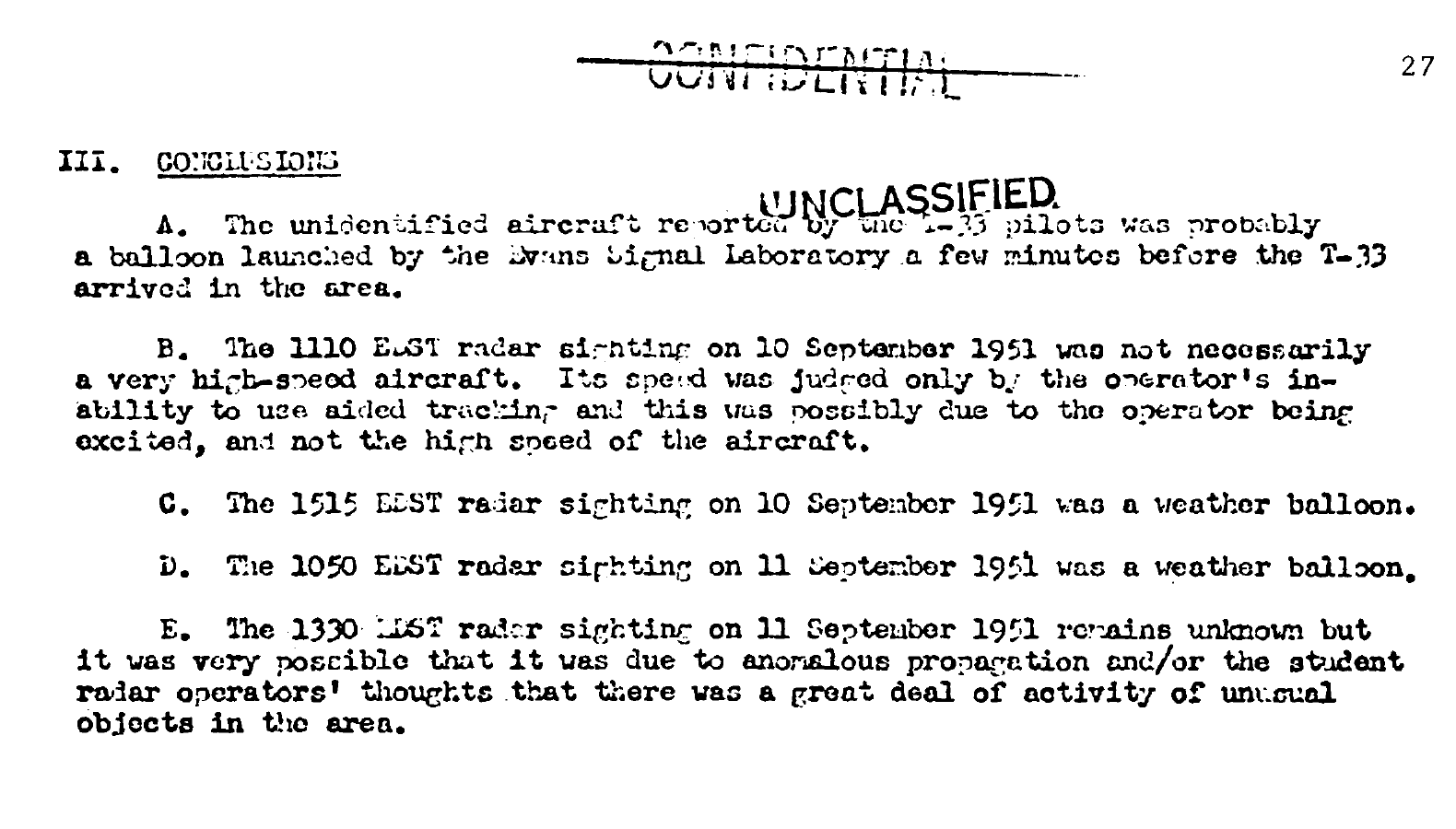
On 10 and 11 September 1951, maintenance students operating Signal Corps radar at Fort Monmouth reported several unusual returns. Separately, at about 11:35 EDST on 10 September, a T-33 crew flying from Dover to Mitchel Air Force Base saw a round silver object near Sandy Hook. Project Grudge Special Report No. 1 did not establish a continuous radar-visual track: it judged the T-33 object probably one of two Evans Signal Laboratory balloons, identified two later radar returns as weather balloons, questioned the initial radar speed estimate, and left a 13:30 return on 11 September unknown but possibly caused by anomalous propagation or operator expectation. No raw plots, radar logs, scope film, verified event photograph, or confirmed ground visual observation survives in the reviewed public record.
This case remains unresolved in the public record, with credibility grade B.
- Documentation
- High documentation
- Primary location
- Fort Monmouth and the New Jersey coast
- Source base
- 8 linked records
- Research use
- Comparison case
What the Fort Monmouth file supports
- Case structure
- The file combines one T-33 visual report and several separate radar reports from 10-11 September; it is not one continuous radar-visual track.[1][2][3]
- T-33 observation
- Two people in the same aircraft saw a round silver object for roughly two minutes; radio monitoring corroborates the report, but no matching radar return is established.[1][4]
- Numbers in conflict
- The first radar return was inferred above 700 mph from tracking failure, recalculated near 420 mph from the stated path and duration, and timed about five minutes differently in field reconstruction.[1][3][5]
- Official findings
- Project Grudge found a probable balloon, two identified weather-balloon returns, one unvalidated speed claim, and one radar return left unknown with conventional mechanisms considered possible.[1]
Case dossier
The case name compresses several reports from 10 and 11 September into one story. The contemporary file uses EDST for its local times; this dossier preserves that abbreviation rather than silently converting it. The reports involve different radar sets, students, an experienced demonstrator, and a T-33 crew in a different location. They must be compared, but they cannot be assumed to describe one object.
At roughly 11: 10 on 10 September, during an AN/MPG-1 demonstration for visiting officers, a low return appeared southeast of Fort Monmouth at about 12,000 yards and moved generally north along the coast before being lost near 14,000 yards. The operator inferred more than 700 mph because full-aided azimuth tracking could not follow it. Yet the same report says it was followed intermittently for about three minutes; its stated ground track and duration imply about 420 mph. A field reconstruction instead placed the observation around 11:15-11:18. With no plot or log, neither time nor speed can be made exact.
At about 11: 35, an Air Force lieutenant flying a T-33 from Dover toward Mitchel Air Force Base saw a round silver object ahead while the jet was near Point Pleasant at 20,000 feet. His passenger, an Air Force major, saw it about 45 seconds later. The crew described a descending object near Sandy Hook, then a turn near Freehold toward the coast; the T-33 descended to 17,000 feet and accelerated from roughly 450 to 550 mph before losing sight of it. Estimated object altitude was 5,000-8,000 feet and size 30-50 feet, but later interrogation recorded uncertainty in the flight path, range, and scale.
The T-33 report was not a confirmed radar-visual observation. A ground station overheard the crew's excited radio conversation, which corroborates that they reported something in flight, not what it was. The later interrogation says neither pilot knew whether the Samworth tracker obtained a return, and an account that it tried and failed to track was not confirmed by them. The relevant Twin Lights radar schedule also left no sensor confirmation. No ground observer reported seeing the same anomalous object.
The remaining radar reports were also separate episodes. At 15:15 on 10 September, SCR-584 serial 473 followed a target to an estimated 93,000 feet; it was a weather balloon being tracked to settle a pool about its altitude. At 10:50 on 11 September, two SCR-584 sets followed a return around 31,000 feet that a later teletype identified as a weather balloon, although Special Report No. 1 says the basis for that identification was unknown. At about 13:30, serial 315 showed a return near Navesink at roughly 6,000 feet that seemed stationary before moving rapidly; overcast prevented a visual check.
These were training-center observations, not preserved operational tracks. The students were learning to diagnose and repair sets on which instructors deliberately introduced faults; after repairs they sometimes operated them tactically. Investigators found no plotting boards, logs, or retained data. Some students could not reliably recall the date or time, and on 11 September they had been told to watch for unidentified objects after word of the previous day's reports circulated. An experienced observer saw one return on a second set, but that strengthens only the existence of a radar return, not an extraordinary interpretation.
Two silver Evans Signal Laboratory balloons had been released at 11:12 on 10 September. Project Grudge calculated that they could have been near 16,000 feet and along the broad Point Pleasant-Sandy Hook line when the T-33 sighting began. A balloon could look disc-like from some angles and appear to turn as the jet maneuvered. But the report openly states that several assumptions about the aircraft and balloon paths were required and therefore the object could not be declared definitely a balloon. The conclusion was probable, not demonstrated.
The field inquiry ran from 28 September to 2 October, and Air Technical Intelligence Center issued Special Report No. 1 on 28 December. Its five findings were mixed: probable balloon for the T-33, no validated extreme speed for the first radar return, weather balloons for the 15:15 and 10:50 returns, and an unresolved 13:30 return possibly explained by anomalous propagation or student expectation. The episode helped prompt a renewed Project Grudge organization, formally established on 27 October and renamed Project Blue Book in 1952. That institutional consequence does not turn the reports into proof of an exotic craft.
Timeline
- An AN/MPG-1 demonstration produces the first reported return. The summary uses about 11:10; the field reconstruction gives about 11:15-11:18.
- Evans Signal Laboratory releases two silver research balloons from the Fort Monmouth area.
- A T-33 pilot and passenger report a round silver object near Sandy Hook and Freehold; ground radio monitoring hears their reaction but supplies no radar confirmation.
- SCR-584 serial 473 tracks a known weather balloon to an estimated 93,000 feet.
- Two SCR-584 sets follow a return near 31,000 feet; a later teletype identifies a weather balloon, though the report does not know how the identification was made.
- SCR-584 serial 315 shows a stationary-then-fast return near Navesink. Overcast blocks visual checking; the final report leaves it unknown and considers anomalous propagation or expectation very possible.
- Air Intelligence Information Report IR-4-51E records the radar reports, personnel experience, set condition, and the spread of the story among students.
- Air Force investigators interview radar personnel and the T-33 crew, inspect training practices, and reconstruct the reports; the surviving transcript notes missing pages and internal inconsistencies.
- The renewed Project Grudge organization is formally established after senior Air Force concern over the case and the broader reporting problem.
- Air Technical Intelligence Center issues Project Grudge Special Report No. 1 with separate findings for the T-33 and four radar episodes.
Fort Monmouth case questions
What happened at Fort Monmouth in September 1951?
Radar students reported several unusual returns on 10-11 September, and a T-33 crew separately reported a round silver object near Sandy Hook on 10 September. The investigation treated these as multiple episodes, not one uninterrupted encounter.
Was Fort Monmouth a radar-visual case?
Not in the strict sense. The T-33 crew's report was heard by radio, but no ground radar return was shown to match its time and geometry, and no ground observer saw the same anomalous object.
How fast and how high were the reported targets?
The numbers belong to different reports. The first radar operator inferred over 700 mph, while the reported track and duration imply about 420 mph. The T-33 crew placed its object around 5,000-8,000 feet; later radar reports included about 31,000 feet, 93,000 feet for a known balloon, and about 6,000 feet for the unresolved return. None is a unified track.
Did Project Grudge explain the T-33 object as a balloon?
It called a balloon probable because two silver research balloons had been released 23 minutes earlier and could fit the broad altitude and drift geometry. The same report said several assumptions were necessary and that a definite balloon identification could not be made.
Did the case create Project Blue Book?
It was an important trigger in the Air Force decision to renew Project Grudge, formally organized on 27 October 1951. The program was renamed Project Blue Book in 1952. Calling Fort Monmouth the sole cause would overstate the historical record.
Are there authentic photos or video of the event?
None was located in the reviewed public record. The displayed image is a cropped page from the 1951 Project Grudge report and shows its conclusions, not the object, a radar display, or a reconstructed route. No video is embedded.
Sources
- [1] ArchiveProject Grudge Special Report No. 1, Fort Monmouth sectionAir Technical Intelligence Center, U.S. Air Force / NICAP scan
- [2] ArchiveAir Intelligence Information Report IR-4-51EU.S. Air Force record / NICAP transcript
- [3] ArchiveFort Monmouth field investigation wire-recording transcriptU.S. Air Force investigation record / NICAP transcript
- [4] ArchiveT-33 pilots' Fort Monmouth interrogation reportU.S. Air Force record / NICAP scan
- [5] ArchiveFort Monmouth radar personnel statementsU.S. Air Force investigation record / NICAP scan
- [6] Official fileHistory Mystery from the ArchivesU.S. Army Communications-Electronics Command
- [7] ResearchCondon Report historical review: Project Grudge and Fort MonmouthUniversity of Colorado Condon Report / NCAS archive
- [8] Official fileNational Archives guide to Project Blue Book recordsU.S. National Archives and Records Administration
The displayed visual is a cropped conclusions page from Project Grudge Special Report No. 1, a declassified U.S. Air Force document. It is evidence of the investigation's wording only, not an event photograph, radar-scope image, flight-path reconstruction, or depiction of the reported object. No authenticated event photo or video was located.