
Australia / 1966 / UNRESOLVED
1966 Westall UFO Incident
At about 10:15 a.m. on 6 April 1966, pupils and staff at Westall High School and Westall State School in Clayton South, Melbourne, reported one or more silver objects moving over the schools and toward a nearby open area known as The Grange. Newspapers covered the event within days, and later interviews preserved many named accounts. The surviving record does not include an authenticated event photograph, the reported television film, radar data or a directly relevant government case file. Aircraft and high-altitude research balloons remain plausible explanations, but the public evidence does not establish a final identification.
This case remains unresolved in the public record, with credibility grade B.
- Documentation
- High documentation
- Primary location
- Melbourne, Victoria
- Source base
- 8 linked records
- Research use
- Comparison case
What the surviving record supports
- Confirmed record
- A daytime observation at two Westall schools was reported by named pupils and staff and covered by newspapers within days.[1][2][3]
- Unverified claim
- No complete contemporaneous record confirms every later claim about three objects, a landing, officials, confiscated material or a school-wide warning.[1][2][3][6]
- Media boundary
- No authenticated event photograph or film is public; surviving documentaries and ABC video are retrospective reporting.[1][3][6][7]
Westall UFO photos, film and original records
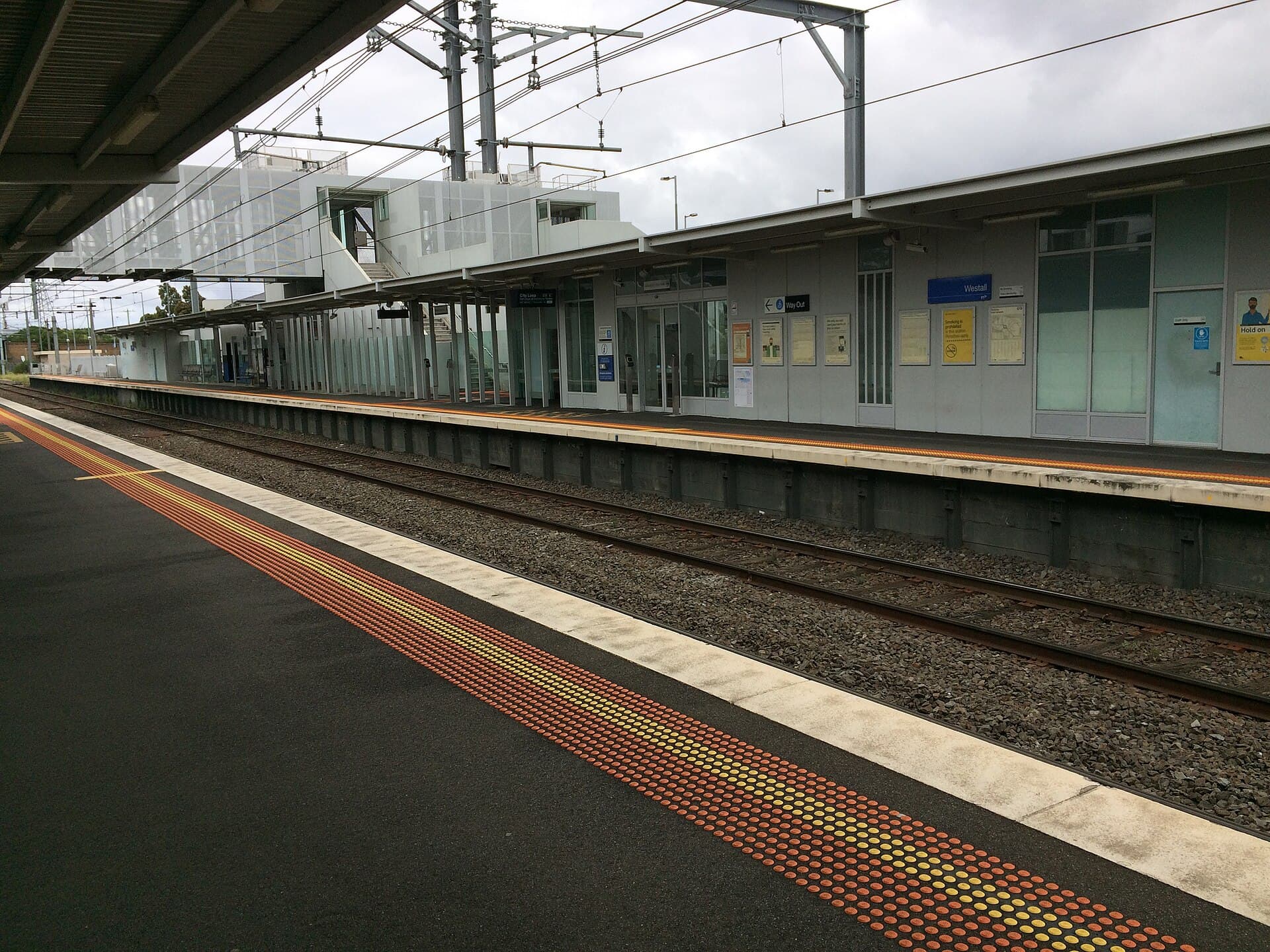
The reviewed sources do not provide an authenticated photograph or film of the reported object. What can be examined is different: contemporary newspaper pages, a published drawing, research interviews and later television reporting. The station photograph above is location context, not a sighting photograph.
- View the 14 and 21 April 1966 newspaper images at State Library Victoria
The Dandenong Journal pages show how the report appeared at the time. The 21 April page includes a student's drawing, not a camera photograph of the object. These scans document publication and testimony; they do not establish an identification.
- Compare contemporary newspaper transcriptions
Project 1947 preserves transcriptions of early reporting. Compare dates and attributed statements with the newspaper images, rather than treating later retellings as a single 1966 account.
- Read the summaries of James E. McDonald's 1967 interviews
This research record helps separate named witness accounts from later retellings. It is not a government identification, a radar track or a recovered film of the object.
- Watch ABC Australian Story's Westall investigation
The 2026 programme presents later witness interviews and discussion of possible explanations. It is retrospective reporting, not the missing Channel Nine film or footage of the object recorded on 6 April 1966.
Case dossier
The school-day observation
At approximately 10:15 a.m. on Wednesday, 6 April 1966, students and staff at Westall High School and the neighboring Westall State School in Clayton South reported unusual objects in a clear daytime sky. Contemporary and later sources differ on the exact number of witnesses and objects, but they consistently place the episode during school hours and describe a rapid movement toward The Grange, an open area opposite the secondary school. The large witness count is a central feature of the case; it is not a precise official census. [1] · [2] · [3]
What witnesses described
Contemporary newspaper accounts used phrases such as dazzling or silver-grey objects, while teacher Andrew Greenwood described a silver-grey form that appeared to thicken as it turned. Some witnesses later recalled a circular or domed object and up to three objects. Several small aircraft were also reported in the area. These descriptions establish a shared observation of something in the sky, but they do not provide measured range, altitude, size or a stable outline from which the object can be identified. [2] · [5] · [6]
Movement toward The Grange
Pupils left classrooms and moved toward the oval or perimeter as the object or objects appeared to travel toward The Grange. Later witnesses recalled a descent, a brief low hover and marks in grass, while others remembered teachers ordering students back inside and a school assembly. Those details are important testimony, but much of their surviving form comes from interviews recorded years or decades later. They should not be treated as if they were all documented in a contemporaneous official statement. [2] · [3] · [6]
The early ground-mark reports
Ground marks were discussed early, not only in reunion interviews. Keith Basterfield’s compilation transcribes a sighting form signed by pupil Joy Tighe on 7 April 1966, describing a roughly ten-yard circle of flattened grass. The original form was not independently located for this review. The 14 April Dandenong Journal also quoted investigator Judith Magee after a Friday visit: her group found circular flattened patches, but she allowed that recent strong winds could account for them. These are early descriptions of vegetation, not a preserved survey or a demonstrated connection between a particular patch and an object landing. [2]
What the 1966 press recorded
The Age reported the sighting on 7 April under the headline 'Object perhaps balloon.' It noted reports by hundreds of pupils and a teacher, small aircraft in the area, and a weather balloon released from Laverton that morning; it also said no commercial, private or Royal Australian Air Force pilot had reported anything unusual. The Dandenong Journal placed Westall on its front page on 14 April and returned to the story on 21 April. These articles confirm rapid public reporting, not the identity of the object. [1] · [2]
Five aircraft are not five confirmed pilot witnesses
The 21 April newspaper’s appeal for five pilots should not become a claim of five independent airborne confirmations. Greenwood described small aircraft near the object. Reporters checked Moorabbin departures: of twelve aircraft that morning, one was on a cross-country flight and the others were doing circuits southeast of the airport, while Westall lay northeast. The paper named pilot Bob Ford, who said he had flown somewhere in the area but noticed nothing unusual. The compilation supplies no five identified confirming aircrew. Nor does an apparent comparison with nearby aircraft measure the object’s distance, size or speed. [2]
The missing visual and physical record
Local-history accounts state that a Channel Nine crew filmed interviews or material at the school, but the footage has not been located. Photographs and field notes attributed to early investigators also have not been recovered in a complete, authenticated chain. Later recollections of a flattened or scorched ground mark lack a preserved contemporaneous survey, sample or measurement. No verified close event photograph, motion picture, radar record or recovered material is publicly available. [1] · [3] · [6]
The Balwyn photograph belongs to another report
A photograph discussed in ABC’s 2026 investigation must be kept separate from the school observation. James Kibel’s Polaroid was reportedly taken at Balwyn four days earlier, on 2 April, not at Westall on 6 April. The article presents competing readings of that photograph rather than an authenticated connection to the school event. Likewise, the Dandenong Journal image credited to pupil Marilyn Eastwood is a drawing of her description. Neither a photograph from a different reported sighting nor a witness illustration fills the missing Westall photographic record. [6] · [1]
Early investigation and later memory
Members of the Victorian Flying Saucer Research Society visited Westall, interviewed witnesses and published material in 1966, but no exhaustive original case file survives publicly. In 1967, atmospheric physicist James E. McDonald interviewed Andrew Greenwood and others while researching UFO reports in Australia. Later documentaries, reunions and oral histories added many named recollections. They preserve valuable testimony while also introducing the normal risks of memory development, shared retelling and retrospective interpretation. [5] PDF 29–30 · [1] · [3]
Greenwood’s own observation in the 1967 interview
A useful check on Greenwood’s personal account is the 2016 summary of McDonald’s 28 June 1967 interview, identified as recording 3T10S103/CD43. It is a later researchers’ summary, not the original audio or a government finding. Greenwood estimated that he watched for about fifteen minutes, adding the girls’ earlier ten minutes to reach a total of twenty-five; that is not twenty-five minutes of his own continuous observation. In his view the object remained airborne. He also said he and Claude Miller later walked to the trees and saw nothing unusual there. That limited visit does not establish what every other witness saw at another place or time. [5] PDF 29–30
Official-record gap and the HIBAL hypothesis
Searches of the National Archives of Australia described by researcher Keith Basterfield did not locate a government file directly resolving Westall. Archive material shows that high-altitude HIBAL research-balloon operations were active in Australia and has led some researchers to propose a balloon or payload as the object. A former HIBAL team member interviewed by ABC in 2026 said he did not recall or find a record of a balloon coming down at Westall. The hypothesis is plausible but not confirmed by a recovery log tied to the school event. [4] PDF 92–93 · [6]
Why the case belongs in the archive
Westall is a well-established mass report because it has a fixed date and place, numerous named witnesses, immediate newspaper coverage and later research interviews. Its limits are equally important: the witness count is approximate, descriptions vary, the alleged film and early field material are missing, no direct official case file is public and no explanation closes every report. The defensible conclusion is that a significant school observation occurred, while the identity and number of objects remain unresolved in the available record. [1] · [2] · [3] · [4] · [5] · [6]
Archive reporting video
ABC Australian Story's 2026 investigation combines later witness interviews, skeptical analysis and the HIBAL hypothesis. It is a retrospective report, not footage recorded on 6 April 1966.
Related video
Related checks and records
Timeline
- Students and staff at Westall High School and Westall State School report one or more silver objects moving toward The Grange in Clayton South.
- School witnesses, teachers and local observers begin giving accounts; later claims about an assembly, officials and ground marks are not preserved in one complete contemporaneous official record.
- The Age publishes 'Object perhaps balloon,' reporting the school observation, small aircraft and a Laverton weather-balloon possibility.
- Victorian Flying Saucer Research Society investigators visit the area and begin interviews, according to surviving research histories.
- The Dandenong Journal places the Westall report on its front page.
- The Dandenong Journal publishes a follow-up that includes teacher Andrew Greenwood's account.
- A Clayton Calendar account is reprinted in the Australian Flying Saucer Review, preserving another early version of the report.
- James E. McDonald interviews Andrew Greenwood and other Australian witnesses during his UFO research visit.
- The documentary Westall '66 brings surviving witnesses and investigator Shane Ryan's research to a wider audience; it is retrospective, not original event footage.
- ABC Australian Story publishes a 60th-anniversary investigation with witness interviews, skeptical commentary and discussion of the HIBAL hypothesis.
Frequently asked questions
What happened in the 1966 Westall UFO incident?
Students and staff at two schools in Clayton South reported one or more silver objects moving rapidly toward The Grange on 6 April 1966.
How many people witnessed the Westall event?
Contemporary reporting referred to hundreds of pupils, while later researchers compiled smaller sets of named interviews. No precise official witness census survives.
Is there an original Westall UFO photo or video?
No authenticated close event image is public. Reported Channel Nine footage and early investigator material have not been located in a complete chain.
Did an object land at The Grange?
Some later witnesses recalled a descent and ground marks, but no preserved contemporaneous survey, sample or image verifies a landing.
Was Westall a HIBAL balloon?
HIBAL operations make a research balloon plausible, but no public flight or recovery record conclusively ties one to the school observation.
Did the Australian government investigate Westall?
Private researchers conducted interviews, but archive searches have not produced a directly relevant government case file or final official identification.
Is the Westall UFO incident explained?
No conclusive identification has been demonstrated. Conventional explanations cover parts of the record, while key distance, image and archival data are missing.
Sources
- [1] ArchiveState Library Victoria reviews contemporary Westall newspaper recordsState Library Victoria
- [2] ArchiveContemporary Westall newspaper reports transcribed by Project 1947Project 1947
- [3] ArchiveCity of Kingston local-history record of the Westall incidentCity of Kingston Local History
- [4] ResearchNational Archives search and the limits of the Westall government recordKeith Basterfield / Project 1947
- [5] ArchiveJames E. McDonald's 1967 Australian witness-interview summariesJames E. McDonald archive / Princeton University
- [6] News reportABC investigates Westall witness accounts and the HIBAL hypothesisABC News Australia
- [7] News reportABC Australian Story: The Westall UFO MysteryABC News In-depth / Australian Story
- [8] ArchiveLicensed 2021 photograph of Westall railway station in Clayton SouthEffluvium1 / Wikimedia Commons
The photograph shows Westall railway station in Clayton South in 2021. It is licensed geographic context, not Westall High School, The Grange, an event photograph or evidence of the reported object.