
United States / 1950 / DISPUTED
Mariana UFO Film (1950)
In August 1950, Great Falls Electrics manager Nicholas “Nick” Mariana and his secretary reported two bright objects near the team's ballpark; Mariana filmed about 16 seconds at 16 frames per second with a 16mm Revere camera. The date usually given is 15 August, although the later Colorado Project found the baseball schedule inconsistent with that date and left 5 versus 15 August open. The Air Force examined the original film in 1950, borrowed it again in 1952, and returned it. Mariana later alleged that roughly 30-35 early frames showing larger, structured images were missing. The case file records that allegation but also an Air Force denial, damaged sprocket holes, a broken frame and repair instructions; it contains no verified admission that frames were deliberately removed. Project Grudge and the 1953 Robertson Panel favored sunlight reflected by two F-94 aircraft. Robert M. L. Baker's 1956 photogrammetric study found aircraft reflections possible but strained and reached no clear conclusion; William Hartmann's 1968 Condon Report case study likewise called the case unexplained while retaining aircraft as a possibility. The public online clip comes from a 1956 documentary and is not the uncut original reel. The archive therefore rates the case B / DISPUTED, not evidence of extraterrestrial technology.
This case is disputed. The archive preserves the claims while separating evidence from interpretation.
- Documentation
- High documentation
- Primary location
- Great Falls, Montana
- Source base
- 5 linked records
- Research use
- Comparison case
What the film record establishes
- Record
- About 16 seconds of 16mm Kodachrome at 16 frames per second survive as a later reprint; two bright images cross fixed landmarks and fade.[1][3]
- Date
- 15 August 1950 is conventional, but the Colorado Project found the baseball schedule inconsistent and left 5 versus 15 August unresolved.[1][3]
- Missing frames
- Mariana alleged 30-35 opening frames were removed. The Air Force denied it; the file documents damage and repair but no verified admission of deliberate removal.[1][3]
Case dossier
The sighting and the uncertain date: Mariana said that while checking wind direction near the Great Falls Electrics' ballpark at about 11:30 a.m., he noticed two bright objects, called his secretary's attention to them and ran roughly 50-60 feet to his car for a camera. The initial record describes metallic or aluminum-like brightness; later accounts add hovering, rotation and a possible rushing sound. These are witness descriptions, not measurements. Although 15 August 1950 became the standard date, the Colorado Project found no Great Falls home game then and treated 5 or 15 August as unresolved.
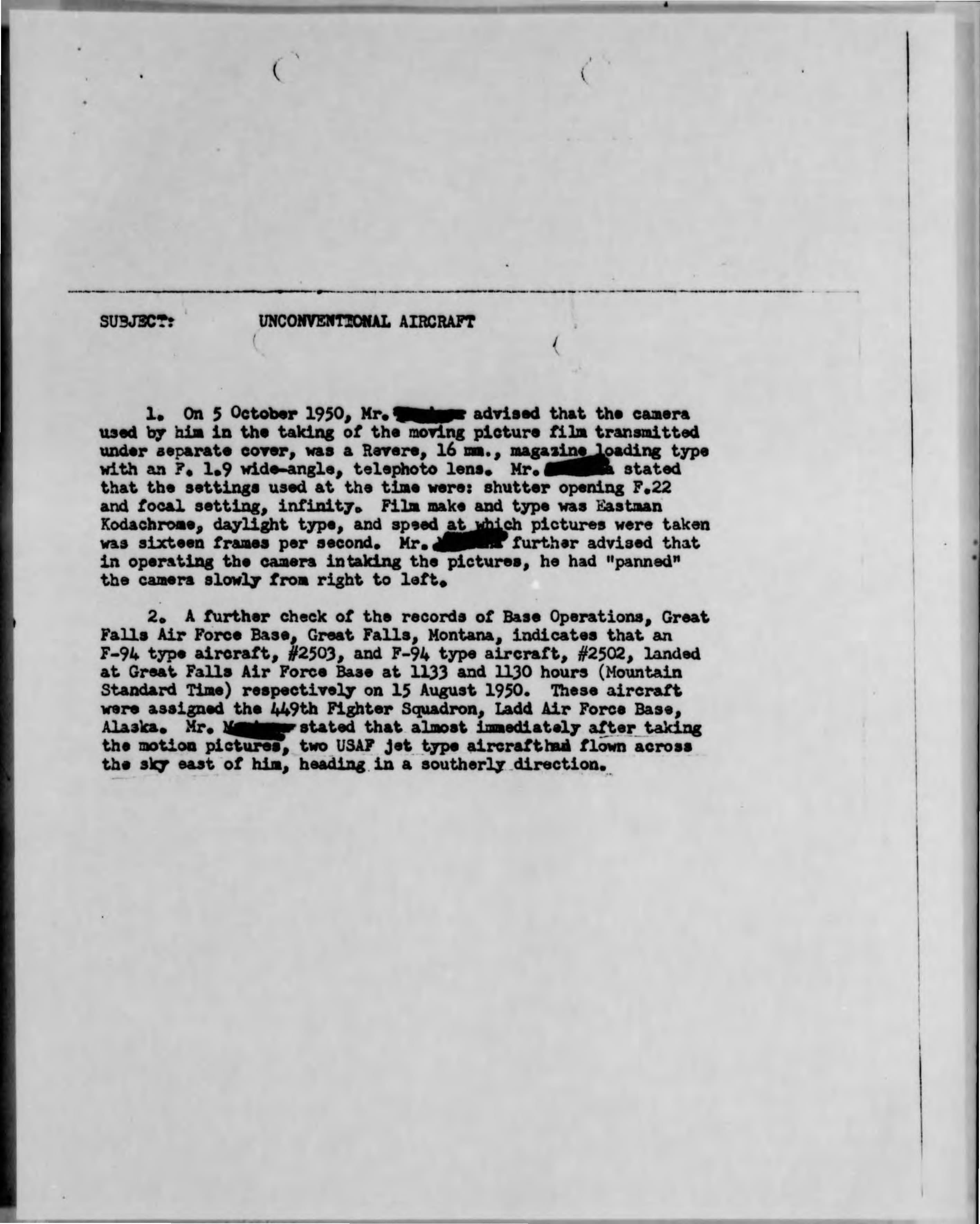
What the 16mm record contains: The case file identifies a Revere turret-type magazine camera, daylight Kodachrome, a 3-inch telephoto lens, focus at infinity, f/22 and 16 frames per second. Baker examined a reprint containing about 230 frames; the two bright images are largest in the first 10-20 surviving frames, keep nearly constant separation, pass fixed structures including a water tower and fade by about frame 225. The film supplies angular motion and image brightness, but no range, altitude or object scale. Baker reported no recognizable structure, color fringe or definite shape even under magnification.
Custody and the missing-frame claim: Mariana first supplied the processed color film to Air Force technical intelligence in 1950. In October 1952 the Air Force wrote that its duplicate had been misplaced and asked to borrow the original again. November correspondence thanked Mariana, said duplicates had been made and reported that a damaged break had been repaired with cellulose tape. Laboratory instructions describe poor condition, stripped sprocket holes, a broken frame and a loose 17-frame section. Mariana told investigators that about 30-35 clearer opening frames had disappeared during the first loan. The Air Force denied that removal, and a 1967 search did not produce the admission letter Mariana remembered. The public record proves a custody dispute, not intentional deletion.
From Grudge to the Robertson Panel: The early Air Force assessment associated the images with two F-94 aircraft whose base records show landings at 11:30 and 11:33. Mariana also reported seeing two jets after filming, which later analysts used both for and against the identification depending on assumed timing and flight path. The CIA-sponsored Robertson Panel viewed the Great Falls film in January 1953 and strongly suspected reflections from aircraft known to be in the area. That is an official analytical judgment, not a measured reconstruction of the filmed path, and the panel's broader conclusion found no evidence of extraterrestrial artifacts or a direct national-security threat.
Baker and the later Colorado review: Working for Douglas Aircraft, Baker analyzed 16mm and 35mm reprints and ran comparison photography of aircraft reflections. He found that bright reflections can create enlarged white blobs like those in the film, but argued that the required duration, viewing geometry, image size and reported hovering made the specific F-94 account strained. His conclusion was explicitly indecisive. In the Colorado Project, Hartmann revisited weather, witness interviews, the film and Baker's work. He judged birds, balloons and meteors poor fits, found the aircraft hypothesis difficult but not excludable, and summarized the case as unexplained. Neither study established a structured craft or extraordinary performance because range remained unknown.
What viewers can actually watch: The widely linked Wikimedia file is a nearly five-minute excerpt from the 1956 feature UFO. It combines a public presentation of Mariana footage with a recreated or edited documentary context, Mariana's testimony and Baker's analysis; it is not a scan of the intact camera original. Wikimedia marks that U.S. film excerpt public domain because it was published without a copyright notice, while warning that status may differ outside the United States. This dossier links that version for study but uses a federal case-file page as its local image, avoiding the claim that a derivative online clip preserves every original frame.
Timeline
- Mariana and his secretary report two bright objects near the Great Falls ballpark; he records about 16 seconds of 16mm Kodachrome.
- The Condon case study found no Great Falls newspaper mention before this date, despite later claims of immediate coverage.
- The Air Force records Mariana's camera settings, aircraft checks and its first case investigation after receiving the film.
- After misplacing its duplicate, the Air Force borrows the original again, makes new copies, repairs a break and returns the film.
- The Robertson Panel views the Great Falls film and strongly suspects aircraft reflections.
- Baker completes his photogrammetric report; the Air Force cites it while retaining its aircraft conclusion, although Baker himself remains undecided.
- Colorado Project interviews and Hartmann's Case 47 review retain aircraft as possible but classify the film case as unexplained.
- A public-domain-in-the-U.S. excerpt from the 1956 documentary is uploaded to Wikimedia Commons; it is a later edited presentation, not the original reel.
Questions about the Mariana film
When was the Mariana UFO film recorded?
Usually 15 August 1950 at about 11:30 a.m., although the Condon/Colorado review found a schedule conflict and left 5 or 15 August unresolved.
Is the surviving footage the original 16mm reel?
No public online file has a demonstrated chain as an uncut scan of the camera original. The familiar clip is an excerpt from the edited 1956 documentary UFO.
Did the Air Force remove frames?
Mariana said about 30-35 early frames were missing, and the Air Force denied removing them. The file documents existing damage and repair, but no verified before-and-after count or admission settles the claim.
What did the Robertson Panel conclude?
It strongly suspected the bright images were sunlight reflections from aircraft known to have been in the area and found no evidence of extraterrestrial artifacts.
Did Baker prove the objects were aircraft?
No. His experiments showed aircraft reflections could look similar, but he called the specific hypothesis strained and ended without a clear-cut conclusion.
What is the most careful conclusion?
The filming and official review are documented. Aircraft reflection is plausible but not reconstructed conclusively; the images do not establish a structured or non-human craft.
Sources
- [1] Official fileProject Blue Book case file: Great Falls, Montana, August 1950U.S. Air Force scan via The Black Vault
- [2] Official fileRobertson Panel meeting report, 14-18 January 1953Declassified U.S. government report / NCAS transcription
- [3] ResearchCondon Report Case 47: Great Falls filmUniversity of Colorado Project / NCAS transcription
- [4] Official fileNational Archives guide to Project Blue Book recordsU.S. National Archives and Records Administration
- [5] Archive1956 documentary excerpt containing the public Mariana footageWikimedia Commons
The displayed image is a federal case-file memorandum, not event footage. The linked public film is an edited 1956 documentary excerpt, not the verified uncut 1950 camera original.