
United States / 1965 / DISPUTED
1965 Exeter UFO incident
In the early hours of 3 September 1965, eighteen-year-old Norman Muscarello reported five brilliant red lights moving low near Route 150 south of Exeter, New Hampshire. Patrolman Eugene Bertrand Jr. returned with him and saw a similar sequence; patrolman David Hunt arrived later and also reported the lights. Signed statements and a 131-page Project Blue Book file document the reports and the Air Force investigation. The file ultimately lists the case as unidentified, but no authenticated event photograph, film, radar record or physical trace is public. Earlier B-47 traffic and a later KC-97 tanker hypothesis provide conventional context without identifying a specific aircraft at the core time and place.
This case is disputed. The archive preserves the claims while separating evidence from interpretation.
- Documentation
- High documentation
- Primary location
- Exeter and Kensington, New Hampshire
- Source base
- 7 linked records
- Research use
- Comparison case
What the surviving record establishes
- Core witnesses
- Muscarello, Bertrand and Hunt signed statements describing five brilliant red lights during one early-morning sequence.[1][2]
- Official record
- A 131-page Project Blue Book file documents the inquiry and ends with an `UNIDENTIFIED` administrative classification.[1][2][3]
- Evidence boundary
- No authenticated event photograph, film, radar track, measured distance or physical trace is public.[1][2]
Official case-file record
Case dossier
The first roadside report. At about 1 a.m., patrolman Eugene Bertrand Jr. stopped beside an upset motorist on Route 108. She said a red-lighted object had followed her and stopped over her car. Bertrand remained with her for roughly fifteen minutes and saw only a distant light that did not appear unusual to him. Her account belongs to the night's reporting context, but the public file does not identify her or establish that she saw the same source as the later witnesses.
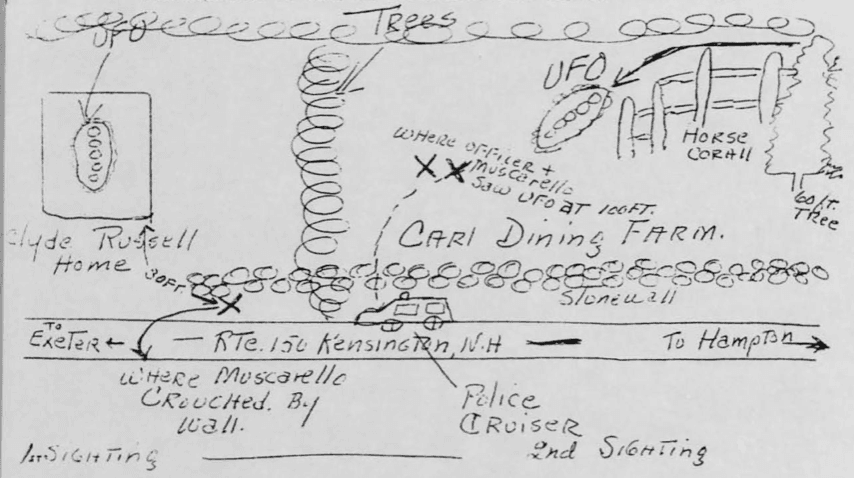
Muscarello's observation. Around 2 a.m., Norman Muscarello was hitchhiking home on Route 150 near the Carl Dining farm in Kensington. His signed statement describes five bright red lights in a slanted line over a house about one hundred feet from where he stood. One light appeared at a time in a repeated sequence, the area was illuminated, and the group moved over a field, disappeared behind trees or a house and reappeared. He watched for about fifteen minutes, at one point taking cover in a ditch, and then ran to the Exeter police station. The stated one-hundred-foot distance was an estimate made in darkness without a resolved object outline.
Bertrand's return to the field. After hearing Muscarello, Bertrand drove him back to the location. The two walked roughly fifty feet into the field before five extremely bright red lights emerged from behind trees. Bertrand said the lights flashed one at a time, approached closely enough that he fell and began to draw his pistol, and moved around the field without sound or vibration. Farm animals became noisy. Like Muscarello, he could not see a form behind the glare; his statement therefore corroborates the light pattern and behavior, not the size or construction of a craft.
Hunt's shorter observation. Bertrand radioed patrolman David Hunt, who arrived minutes later. Hunt's statement records a group of bright red lights flashing in sequence about half a mile across the field. After a short observation, he saw the group move southeast and disappear while remaining at an estimated low altitude. Hunt adds a third named observer, but his greater distance and shorter viewing time make his account more limited than the first two.
What the witnesses could not measure. All three accounts concern brilliant lights rather than a clearly outlined body. None provides a calibrated distance, angular size, measured altitude, photograph, film or instrument record. Apparent closeness, low altitude and object size were inferred from brightness, movement against trees and the witnesses' fear. Those impressions are important testimony, but they cannot be converted into reliable speed or dimensions without a known range.
The Pease AFB inquiry. Major David H. Griffin visited the area, interviewed the witnesses and reported that he could find no probable cause. He described Muscarello and the two patrolmen as stable and reliable. The weather was clear, with a reported low-level temperature inversion. Griffin also noted five B-47 aircraft in the wider area but wrote that he did not believe they were connected to the sighting. This is evidence of a prompt official inquiry, not a technical identification of the lights.
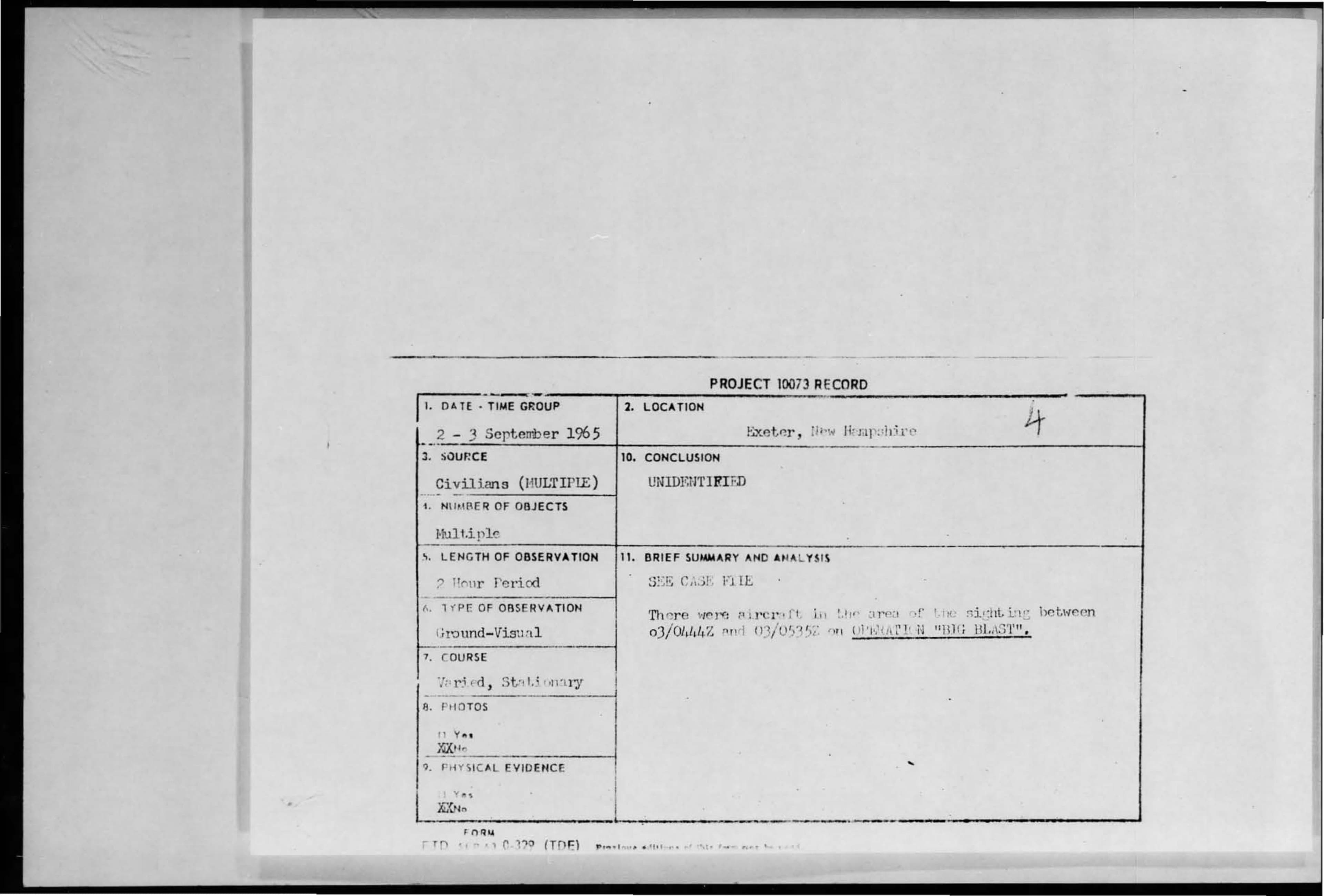
Big Blast and the timing problem. Air Force correspondence later examined a SAC/NORAD exercise called Big Blast and ten B-47 approaches to Pease between about 12:44 and 1:35 a.m. local time. The file treated some earlier regional reports as likely exercise traffic, but the central Muscarello-Bertrand-Hunt sequence occurred after 2 a.m. The two patrolmen wrote on 2 December that they saw a probable B-47 only after the red lights had gone and did not believe the aircraft was related. The public paperwork never matched a specific aircraft to the core observation.
Classification and later debate. A Project Blue Book record card lists the Exeter case as `UNIDENTIFIED`, and a February 1966 Air Force letter says additional information still did not permit identification. In 2011, James McGaha and Joe Nickell proposed a KC-97 tanker whose five sequenced red receiver lights and angled refueling boom could resemble key details. The match is suggestive, but the article did not produce a flight or refueling log placing a KC-97 over the field at the core time, while the official file includes negative replies for relevant refueling activity. The case therefore remains disputed rather than either proved extraordinary or securely solved.
Related checks and records
- Betty and Barney Hill: early reports and later recollections
Compare a dated 1961 interview, later hypnosis and separate radar records without treating them as equivalent evidence.
- Michigan 1966: the scope of the swamp-gas explanation
Compare the witness reports, misattributed photograph, Air Force statement and Ford's demand for an inquiry.
Timeline
- Bertrand met a distressed motorist on Route 108 who said a red-lighted object had followed her; he saw only a distant light.
- Muscarello reported five brilliant red lights moving near Route 150 and watched for about fifteen minutes.
- Muscarello reached the Exeter police station and gave an immediate account while visibly shaken.
- Bertrand drove Muscarello back to the field; both reported the five sequenced red lights at closer apparent range.
- Hunt arrived after Bertrand's radio call and reported the lights from farther away before they departed southeast.
- Pease AFB received the report and began witness interviews and local checks.
- Major Griffin reported no probable cause and described the three named observers as stable and reliable.
- Air Force correspondence checked Big Blast, B-47 traffic, refueling activity, airport lighting and other conventional possibilities.
- Bertrand and Hunt wrote that the main sighting occurred after 2 a.m. and that a later B-47 did not resemble the reported lights.
- The Air Force wrote that it remained unable to identify the object; the Project Blue Book record card lists the case as unidentified.
Frequently asked questions
What happened in the 1965 Exeter UFO incident?
Norman Muscarello and patrolmen Eugene Bertrand Jr. and David Hunt reported five brilliant red lights flashing in sequence and moving near a field south of Exeter during the early hours of 3 September.
Did police officers see the Exeter lights?
Yes. Bertrand reported the lights at apparent close range after returning with Muscarello, and Hunt reported them from farther away. Neither officer could see a clear body behind the glare.
How did Project Blue Book classify the Exeter case?
The surviving record card says `UNIDENTIFIED`, and a February 1966 Air Force letter says the available information still did not permit identification. That is an unresolved file status, not proof of an extraterrestrial craft.
Was the Exeter incident caused by Operation Big Blast?
The exercise and B-47 traffic explain some earlier reports, but the documented approach window ended before the core post-2 a.m. sighting. The officers also distinguished a later B-47 from the red lights.
Does a KC-97 tanker explain the Exeter lights?
It is a plausible later hypothesis because the KC-97 had five sequenced red lights and an angled refueling boom. No public flight or refueling log, however, places a specific KC-97 at the field during the central sighting.
Are there real photographs or videos of the Exeter UFO?
No authenticated event image is public. The images on this page are a hand-drawn site sketch and an Air Force record card from the case file; neither shows the reported lights.
Does the Exeter incident prove an extraterrestrial craft?
No. It is a well-documented unresolved visual report. Missing measurements and sensor evidence prevent secure identification, and an unidentified administrative label does not determine origin.
Sources
- [1] Official fileNational Archives catalog: Exeter Project Blue Book case fileU.S. National Archives and Records Administration
- [2] ArchiveProject Blue Book Exeter case file, 131 pagesU.S. Air Force / Wikimedia Commons
- [3] Official fileProject Blue Book records and Air Force conclusionsU.S. National Archives and Records Administration
- [4] ResearchExeter Incident Solved? The KC-97 hypothesisSkeptical Inquirer
- [5] ArchiveNICAP Exeter report archiveNICAP
- [6] News reportRadio Field Trip: Learning About UFO Encounters in ExeterNew Hampshire Public Radio
- [7] News reportNorman Muscarello recalls the Exeter incidentSeacoastNH
The main image is a hand-drawn site sketch preserved in the Project Blue Book file. It identifies roads, houses, trees, the police car and reported viewing positions, but it is not an event photograph, measured survey or proof of a craft. The supplementary image is an official record card. No authenticated event photograph or original video is publicly available.