
France and Germany / 1944 / UNRESOLVED
Foo fighters of World War II
“Foo fighters” were not one object or one encounter. In the strongest surviving file, the 415th Night Fighter Squadron's intelligence officer compiled reports from different sorties between 14 December 1944 and 30 January 1945: single glows, paired lights, rows of lights and distant groups near Erstein, Haguenau, Worms, Lunéville, Strasbourg, Saverne and other Rhine-area locations. Some seemed to follow or approach aircraft; others remained distant or stationary. Ground-control replies were negative when crews asked about enemy aircraft, but the packet contains no raw radar plot or confirmed radar detection of the lights. Allied intelligence considered Me 262 jets and flak rockets and admitted the evidence was too sketchy and varied for a satisfactory answer. Optical afterimages, St. Elmo's fire, atmospheric effects and ordinary combat lights were also proposed, without a case-by-case reconstruction. Pacific “balls of fire” and later recollections belong to related but separate records. The archive therefore documents genuine wartime reporting and official uncertainty, not an extraterrestrial craft or a single unresolved machine.
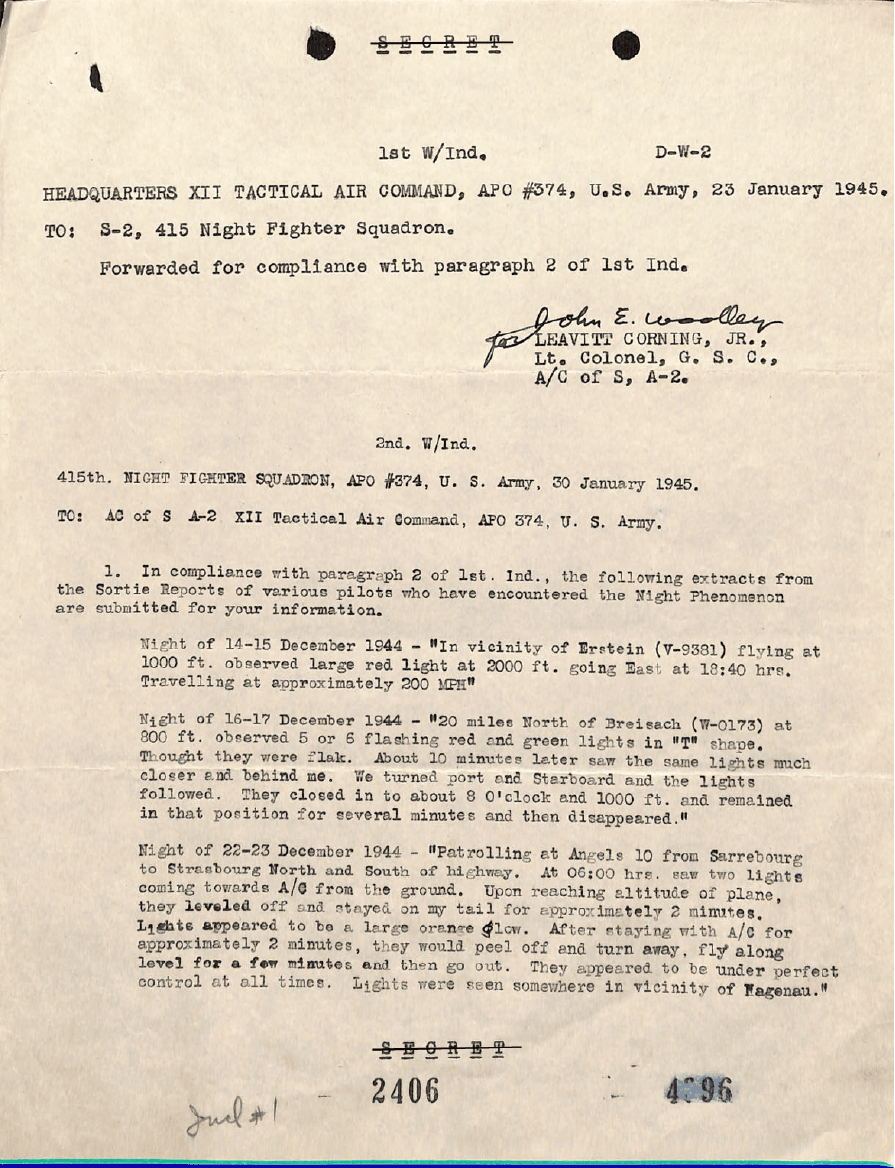
This case remains unresolved in the public record, with credibility grade B.
- Documentation
- High documentation
- Primary location
- Rhine region; related reports in other World War II theaters
- Source base
- 5 linked records
- Research use
- Comparison case
What the wartime foo-fighter record establishes
- Confirmed record
- Dated 415th sortie extracts and signed SHAEF correspondence document multiple separate light reports and an intelligence review.[1]
- Not one event
- Colors, numbers, locations, motions and durations differ; Pacific reports are related history, not corroboration of one Rhine object.[1][5]
- Radar boundary
- Negative GCI replies concerned queried enemy aircraft. The reviewed packet contains no positive radar track of the lights.[1]
- Official assessment
- Me 262s and flak rockets were proposed for parts of the cluster, while officials said the varied evidence permitted no definite answer.[1]
Case dossier
The documented European core: The SHAEF packet does not begin with a generic November date. Its earliest dated 415th extract is the night of 14–15 December 1944 near Erstein, where a crew reported a large red light at about 2,000 feet moving east. Later entries describe different geometries and locations. The dossier therefore treats late-1944 foo fighters as a report cluster, not a continuous track.
Haguenau and the following nights: For 22–23 December, one crew reported two lights rising from the ground, reaching the Beaufighter's altitude and remaining behind it for about two minutes before turning away. The next night's file entries instead mention distant reddish flames and a separate glowing red object. On 26–27 December, reports include yellow streaks, rows of white lights, a light near Worms said to follow for five minutes and other groups. Similar words do not make these one event.
What the crews and instruments establish: The January compilation is one step removed from the original sortie forms because Ringwald submitted extracts. It records visual estimates of color, altitude, distance and duration. In every recorded instance where a pilot called Ground-Controlled Interception about a “bogey aircraft,” the answer was negative. That narrows one question—no enemy aircraft was reported in those queried areas—but is not a positive radar observation of a foo fighter. No raw scope photograph, radar plot, gun-camera film or calibrated optical record is in the packet.
How intelligence handled the reports: XII Tactical Air Command forwarded the material up the chain. On 11 February 1945, SHAEF Air Staff said the number of reports and the crews' evident concern justified getting to the root of the matter and suggested a technical-intelligence visit for first-hand interviews. The surviving packet shows referrals to the British Air Ministry and scientific staff. It does not contain the proposed interview report, a laboratory analysis or a final identification for each sortie.
The official explanation was provisional and plural: The British Air Ministry wrote on 13 March that a few alleged aircraft might have been Me 262 jets and suggested flak rockets for the rest, while calling the evidence “very sketchy and varied” and the affair still a mystery. SHAEF repeated those candidates on 16 March and regretted that no more definite information could be given. This is an intelligence assessment of possibilities, not proof that rockets or jets reproduce every reported movement.
Contemporary press changed the frame: By 2 January 1945, syndicated U.S. newspaper coverage had made the squadron's nickname public and described the lights as a possible German weapon. TIME's 15 January article reported varying descriptions and listed afterimages and St. Elmo's fire alongside speculative weapon mechanisms. These articles are valuable evidence of what was being said during the war, but they are not independent sensor records and sometimes generalize beyond the dated sortie extracts.
Pacific reports and later compilations: “Foo fighter” later became a broad label for wartime aerial mysteries. The Wyoming American Heritage Center compilation includes European and Pacific entries drawn from official papers, books and interviews decades later. Pacific reports often concern large, distant “balls of fire” rather than the 415th's close-looking Rhine lights. They should be researched as separate incidents. The compilation is a finding aid and secondary synthesis, not evidence that one technology operated across theaters.
Timeline
- Earliest specifically dated 415th report in the reviewed SHAEF packet: a large red light near Erstein.
- A crew reports two lights rising near Haguenau and staying behind its Beaufighter for about two minutes.
- Separate sorties report streaks, rows, paired lights and distant groups at several Rhine-area locations.
- The first wave of syndicated U.S. newspaper coverage makes the name and weapon speculation public.
- Intelligence officer F. B. Ringwald submits dated sortie extracts and records negative GCI replies when enemy aircraft were queried.
- SHAEF requests deeper technical investigation and first-hand crew impressions.
- The Air Ministry and SHAEF suggest Me 262s and flak rockets but state that the varied evidence permits no satisfactory or definite answer.
- The U.S. government releases the 17-page SHAEF packet through PURSUE.
Questions about the World War II foo fighters
What were the World War II foo fighters?
A wartime nickname, first strongly documented with the 415th Night Fighter Squadron, for varied unidentified lights reported on separate missions. It later broadened to other theaters and report types.
Did radar track the foo fighters?
The reviewed SHAEF packet does not contain a positive radar track. It says GCI gave negative replies when crews asked whether enemy aircraft were in certain areas. That is not the same as radar confirmation of the lights.
What did Allied intelligence conclude?
It proposed Me 262 jets for a few aircraft-like reports and flak rockets for others, but explicitly said the evidence was too sketchy and varied for a satisfactory or definite explanation.
Were European and Pacific reports the same phenomenon?
The public record does not establish that. Pacific “balls of fire” often differ in appearance, distance, location and source chain. They belong to the wider history of the label but require separate incident analysis.
Is there an authentic photo or film of a foo fighter?
No authenticated event image or original event film was found in the reviewed official and university holdings. The page displays a public-domain military report scan and labels it as a document.
Do the reports prove extraterrestrial craft?
No. They prove wartime reports and official uncertainty. The absence of a complete identification for every light does not identify an extraterrestrial, non-human or exotic cause.
Sources
- [1] Official fileSHAEF Night Phenomena (foo fighters) file, 1944–1945U.S. Department of War / SHAEF Air Staff
- [2] Official filePURSUE federal release portalU.S. Department of War
- [3] News reportTIME: Science — Foo-FighterTIME
- [4] ArchiveIndianapolis Times, 2 January 1945Indiana State Library
- [5] ResearchThe Foofighters FilesUniversity of Wyoming American Heritage Center
The displayed image is an official 1945 report page, not event photography. No authenticated original image or film of the reported lights was found in the reviewed holdings.