
Papua New Guinea / 1959 / UNRESOLVED
Father Gill Papua New Guinea sighting
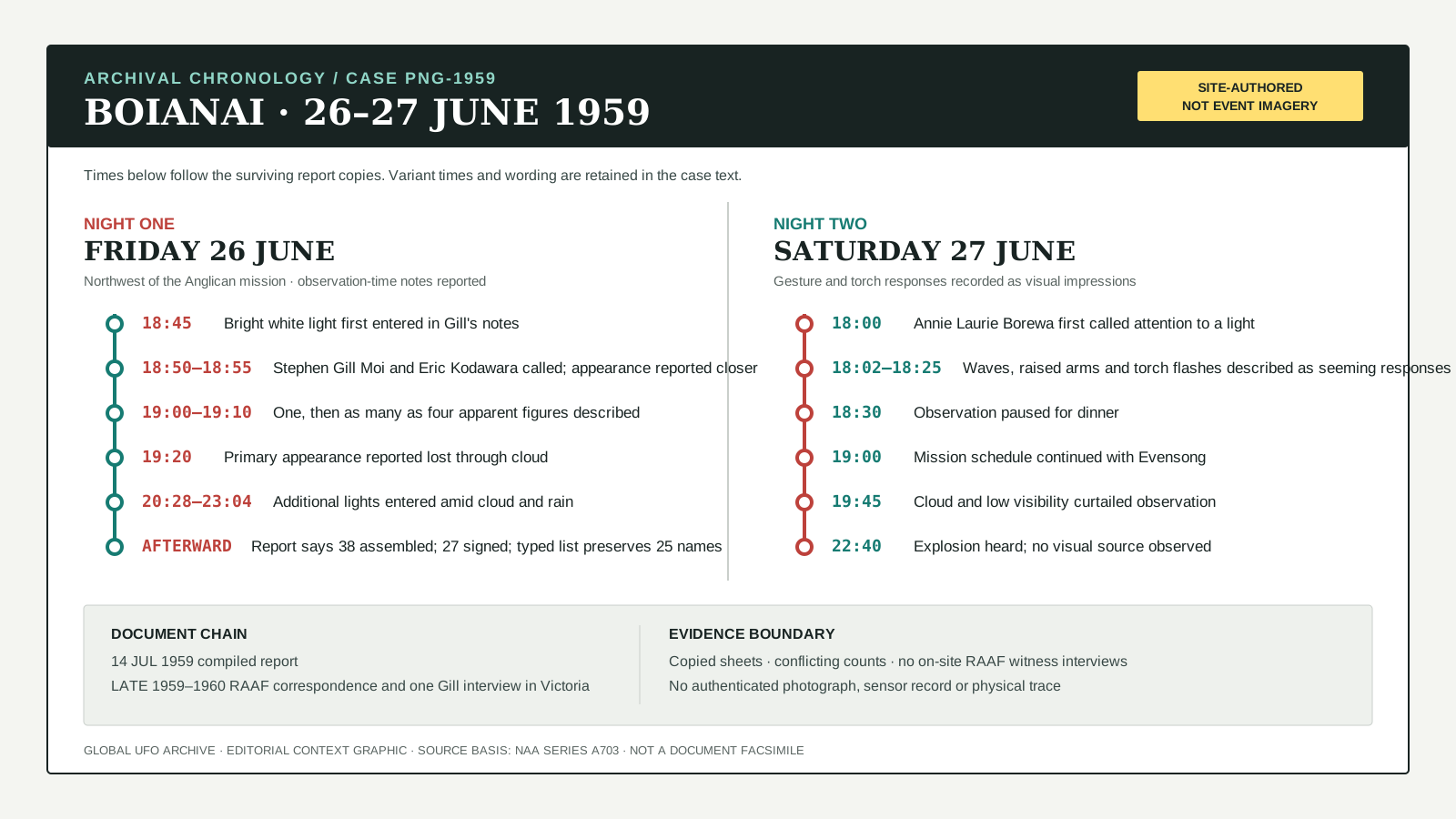
The Father Gill or Boianai sighting is a documented two-night witness report, not a verified encounter with extraterrestrial occupants. At 6:45 p.m. on 26 June 1959, Anglican priest William B. Gill began time-stamped notes about a bright light northwest of the mission; he and named Papuan teachers, medical assistants and residents later described a structured appearance, changing lights and figures that seemed to stand above it. On 27 June, Annie Laurie Borewa first called attention to a similar light at 6:00 p.m. Gill wrote that one apparent figure seemed to copy his wave, others seemed to answer Ananias Rarata's two-arm gesture, and the light appeared to waver after Eric Kodawara aimed a torch. Those are attributed visual impressions, not confirmed communication. Gill's 14 July compilation says 38 people were assembled after the first observation and 27 voluntarily signed, while the surviving typed witness sheet lists 25 names; other copies give different times, measurements and wording. Australian Air Force Intelligence interviewed Gill months later but did not interview the Boianai witnesses in Papua. It proposed planets, refraction and moving cloud for at least some lights, reached no positive identification and rejected the claim of manned space vehicles. With no authenticated event image, instrument data or physical trace, the core report remains unresolved rather than established as a craft-and-occupant event.
This case remains unresolved in the public record, with credibility grade B.
- Documentation
- High documentation
- Primary location
- Boianai Anglican mission, Milne Bay
- Source base
- 8 linked records
- Research use
- Comparison case
What the surviving record establishes
- Two-night record
- Gill's surviving packet dates its main observations to 26 and 27 June 1959 and says the first-night times were copied from notes made during the observation.[1][2]
- Witness record
- The report says 38 people assembled and 27 signed, but the surviving typed list has 25 names, including teachers, medical assistants and residents; it is not 38 separate statements.[1][2]
- Reported gestures
- On 27 June Gill described apparent figures seeming to answer waves and a light seeming to react to torch flashes. These are reported perceptions, not verified communication.[1][2]
Case dossier
Boianai was a coastal village and long-established Anglican mission station about twelve miles from Dogura. In 1959 it lay in the Australian-administered Territory of Papua and New Guinea. Gill was the priest at the station, and the witness community included teachers, medical assistants, school residents and other mission members. That institutional setting explains why names, occupations, letters to clergy and an Evensong interruption appear in the record. It does not make every observation accurate, but it is more specific than the later shorthand of one priest and an anonymous crowd.
The paper trail began before the famous evenings. Teacher Stephen Gill Moi described a bright light at 1:00 a.m. on 21 June; Gill wrote the account from Moi's dictation on 23 June and sent it with a cautious letter to the Reverend David Durie at St Aidan's College, Dogura. In that letter Gill considered electrical effects, unconscious influence from saucer illustrations and an Earth-made device, and said he still required scientific evidence for an outer-space theory. A second covering letter dated 27 June says the previous night changed his view. These letters, the live data sheet and later annotations survive as reproduced pages inside civilian material lodged in RAAF files, not as a complete set of verified autograph originals.
On Friday 26 June, Gill's data sheet starts at 6: 45 p.m. with a bright white light to the northwest. At 6:50 he called Stephen and Eric; at 6:52 Stephen arrived and reportedly distinguished it from the earlier star-like light. Between about 6:55 and 7:12, the sheet records a less brilliant orange or deep-yellow appearance, first one and then several luminous shapes described as men, and a thin blue beam. Named annotations associate parts of this interval with Gill, Stephen Gill Moi, Ananias Rarata and Nessie Moi. At about 7:20 the reported appearance passed through cloud. Later entries from 8:28 to 11:04 describe several lights, cloud crossings, apparent color changes, overcast and finally heavy rain. Height, distance, speed and hand-span values were estimates, not instrument readings.
Gill later described a deliberate witness procedure after the first display: 38 people were brought into a lit room; Gill, Ananias Rarata and Stephen Gill Moi drew separately; and observers were told to sign only if they believed the sketches represented what they had seen. That appendix says 27 of 38 signed. A surviving typed sheet headed as signatures lists 25 names, including Dulcie Freda Guyorobo, Ilma Violet Iorere, Annie Laurie Borewa, Love Daisy Kolauna, Ananias Rarata, Nessie Moi, Stephen Gill Moi and Eric Kodawara. A separate annotation says a chief-observer paper was signed at 7:30 p.m.; the typed majority-witness sheet says 7:45 p.m. The likely existence of several papers and copied versions prevents one exact signature total or time from being treated as settled.
On Saturday 27 June, Annie Laurie Borewa reportedly noticed the large light at 6:00 p.m.; Gill joined at 6:02 and described a group of about twelve. He wrote that four apparent figures came and went above the light. When he raised one arm, one seemed to do the same; when Ananias raised both arms, two and then all four seemed to answer. Gill then had Eric Kodawara fetch a torch and sent long flashes. The light appeared to make side-to-side wavering motions and then to grow larger before stopping. At 6:25 two figures were reported again; at 6:30 Gill went to dinner, and at 7:00 the observers left for Evensong. Cloud covered the sky by 7:45. A loud 10:40 explosion was not accompanied by a sighting, and Gill himself allowed that it could have been atmospheric and might be unrelated.
Gill assembled the longer report at Boianai on 14 July. Its evidentiary core is his copied time sheet, diagrams, named witness material and explicit discussion of hallucination, suggestion, atmospheric illusion and inexperienced observers. Around that core, the Victorian Flying Saucer Research Society added an introduction that treated advanced craft and humanoids as effectively established; that advocacy is not Gill's language and is not a government finding. Copies entered Australian files after civilian researchers contacted the Directorate of Air Force Intelligence in September. Squadron Leader F. A. Lang later interviewed Gill in Victoria. The two-page report forwarded on 8 January 1960 was interview-based and did not test the other witnesses, the site or local weather records in Papua.
Later readings remain divided. The RAAF suggested that rough bearings placed at least three lights near Jupiter, Saturn and Mars, with refraction and fast-moving cloud producing apparent size or motion; its February 1960 letter nevertheless said no positive conclusion was possible. Donald Menzel later proposed Venus distorted by uncorrected eyesight, eyelashes and cloud, while J. Allen Hynek replied that Gill wore corrected glasses and had identified Venus separately. A 1967 James E. McDonald interview preserves Gill's later recollection, but Gill admitted dates and some detail had faded after eight years. Bill Chalker later reported that Hynek visited Boianai in 1973 and found six witnesses who supported Gill; the accessible public record here does not include those interview transcripts. Planet and cloud hypotheses may fit some point lights and changing appearances, but no public analysis conclusively accounts for the full two-night testimony. Conversely, testimony and copied sketches cannot prove a manufactured craft, occupants or extraterrestrial origin.
Timeline
- Teacher Stephen Gill Moi reports an earlier light; Gill records the account from Moi's dictation on 23 June.
- Gill begins a live data sheet after seeing a bright white light northwest of the Boianai mission.
- The notes describe changing color, apparent figures and a thin blue beam; named annotations identify Gill, Stephen Gill Moi, Ananias Rarata and Nessie Moi for parts of the sequence. The appearance then passes through cloud.
- One copied annotation dates a chief-observer paper to 7:30 p.m.; the typed majority-witness sheet gives 7:45 p.m. The records may refer to different papers.
- The data sheet records several later lights, cloud crossings and apparent color changes before overcast and heavy rain. These later point lights are not all necessarily the same phenomenon as the earlier structured appearance.
- Annie Laurie Borewa first notices a similar light. Gill records apparent figures, gestures that seemed reciprocated and an apparent wavering response after torch flashes; he leaves for dinner at 6:30.
- The group leaves for Evensong at 7:00; cloud limits visibility by 7:45. A loud 10:40 explosion has no visual correlate, and Gill notes it may be atmospheric and unrelated.
- Gill dates his compiled Boianai report. It combines copied observation notes, diagrams, witness material and a methodological appendix that discusses alternative explanations and estimate limits.
- Civilian groups alert Air Force Intelligence, which obtains the report and interviews Gill in Victoria. The RAAF proposes planets, refraction and cloud for some lights, reaches no positive conclusion and says it does not believe the reports describe manned space vehicles.
- James E. McDonald records a one-hour retrospective interview with Gill in 1967. Bill Chalker later reports that J. Allen Hynek visited Boianai in 1973 and located six supporting witnesses; public transcripts of those six interviews were not found.
Questions about the Boianai sighting
What did Father Gill report at Boianai?
Gill and other mission residents reported bright lights and a large structured appearance northwest of the station on two evenings, with figures that seemed to stand above it. The record documents their descriptions, not an independently measured craft.
How many people witnessed the events?
No single total is secure. Gill's appendix says 38 people were assembled and 27 signed; the surviving typed sheet lists 25 names. The second evening began with a group described as about twelve. These are overlapping group records, not independent statement totals.
Were Gill's notes made during the sighting?
The first-night sheet is time-stamped from 6:45 to 11:04 p.m., and Gill later said its data were copied from notes made during the observation. Public scans are reproduced or typed copies, however, and contain date and measurement errors, so they should not be described as a complete untouched original notebook.
Did the reported figures wave back?
Gill wrote that one apparent figure seemed to copy his wave and that figures seemed to answer Ananias Rarata's raised arms. A torch sequence was also interpreted as a response. No instrument or independent close-range record confirms communication, so the wording must remain seemed or appeared.
What did the RAAF investigate and conclude?
After civilian organizations alerted it, Air Force Intelligence obtained the report and had Squadron Leader F. A. Lang interview Gill in Victoria. The surviving record shows no Boianai site visit or interviews with the named Papuan witnesses. It proposed planets, refraction and moving cloud, reached no positive conclusion and said it did not believe manned space vehicles were involved.
Can planets and cloud explain the case?
They plausibly explain some point lights, brightness changes and apparent motion through broken cloud, and deserve case-specific testing. The surviving RAAF work does not calculate every time and bearing, while a planet alone does not recreate the reported figures and gestures. The public evidence is insufficient either to identify every appearance naturally or to establish an extraordinary craft.
Sources
- [1] Official fileNAA A703, 554/1/30 Part 1: Gill report and Air Force correspondenceNational Archives of Australia / UFO Transparency facsimile
- [2] Official fileNAA A703, 580/1/1 Part 2: reproduced Gill papers and related submissionsNational Archives of Australia / UFO Transparency facsimile
- [3] ResearchAustralian government records study of unusual aerial sightingsAustralian UFO Research Association / Project 1947
- [4] ResearchSummary of James E. McDonald's 1967 interview with William GillUFO Research Queensland / Keith Basterfield and Anthony Clarke
- [5] ResearchAPRO's 1973 review of New Guinea reports and competing analysesAerial Phenomena Research Organization / IAPSOP archive
- [6] Archive1923 Anglican history of Boianai and the south-eastern mission districtProject Canterbury / Anglican History
- [7] ResearchBill Chalker's later review of the Father Gill caseThe Black Vault / Bill Chalker
- [8] ArchivePapua New Guinea retrospective on the Boianai reportPost-Courier
The displayed image is a site-authored archival chronology, not event imagery, a document facsimile or a craft reconstruction. No authenticated event photograph, film, sensor record or physical sample was found. Public file scans are linked as sources instead of republished as active media.