
United States / 1953 / UNRESOLVED
Kinross incident
On 23 November 1953, U.S. Air Force F-89C 51-5853A left Kinross Air Force Base with pilot 1st Lt Felix Moncla Jr. and radar observer 2nd Lt Robert Wilson to identify a radar track over Lake Superior. The mishap report says ground control vectored the interceptor, saw its return merge with the other return at about 18:55 EST, and then lost the F-89 return and IFF signal. A separate RCAF search report confirms the contact loss and unsuccessful five-day search, but not a collision or target identity. The USAF identified an RCAF C-47; later Canadian-record claims complicate that identification. No wreckage, raw radar record, or demonstrated cause is public.
This case remains unresolved in the public record, with credibility grade B.
- Documentation
- High documentation
- Primary location
- Lake Superior
- Source base
- 4 linked records
- Research use
- Comparison case
What the Kinross record supports
- Confirmed loss
- F-89C 51-5853A, Moncla, and Wilson disappeared during an active air-defense mission on 23 November 1953.[1][2]
- Radar boundary
- The mishap report says the returns merged on a scope; no raw plot or scope film is public, and the wording does not prove physical contact.[1]
- Independent search record
- The RCAF recorded 29,600 square miles searched and 143 hours 25 minutes flown before active searching ended with no trace.[2]
Case dossier
The missing aircraft was F-89C 51-5853A, assigned to the 433rd Fighter-Interceptor Squadron at Truax Field and temporarily operating from Kinross for air-defense duty. The pilot was 1st Lt Felix Eugene Moncla Jr.; 2nd Lt Robert L. Wilson served as radar observer. A maintenance statement records a thorough preflight at about 07:30, no discrepancies, an earlier one-hour sortie marked "ok," and no difficulty before the evening takeoff. That is useful service-history evidence, but it cannot rule out a failure after departure.
The F-89 became airborne at 18: 22 EST (23:22Z) on an active air-defense mission. The mishap form describes the initial track as an unknown aircraft about 160 miles northwest of Kinross. "Naples" ground-controlled interception station first handled the fighter; at 18:41, "Pillow" GCI assumed control while the F-89 was at 30,000 feet. These times come from the later accident packet, not from a surviving minute-by-minute radio transcript.
At 18: 47, Pillow directed the interceptor down to 7,000 feet. At 18:51, Moncla was told to turn to heading 020 for a cut-off; the target was reported at eleven o'clock and ten miles. The mishap form places the last radio contact at about 18:52 and says that at about 18:55 the unknown and F-89 returns "merged together on the radar scope." The expanded summary says the other return continued on its original path while the F-89 return disappeared; the IFF signal was then lost.
That radar sentence is evidence of what the accident report says operators saw, not direct access to the display. The public release contains no raw plot, scope film, recording, full controller statement, or engineering analysis of the track. A convergence of plotted returns does not by itself demonstrate impact, capture, or even zero physical separation. No accessible record says Moncla visually acquired the target, and the C-47 pilot later quoted by UFOBC said his crew saw neither aircraft lights nor the F-89.
Weather over eastern Lake Superior supplied a serious operational hazard. The American and Canadian reports describe stratocumulus with bases around 2,000-3,000 feet and tops near 6,000-8,000 feet, isolated snow showers reducing visibility to one or two miles, and moderate to heavy icing possible in cloud up to roughly 7,000 feet. The interceptor had descended to that altitude shortly before contact ended. These conditions make weather, icing, spatial disorientation, or mechanical trouble plausible, but no distress call, wreckage, or causal finding selects one of them.
The RCAF's Operation SAR Scorpion report is an independent official record of the response. It says Canadian rescue coordination was alerted at 22:00 on 23 November and places the loss of radio and radar contact at 18:55 near 48°00'N, 86°49'W. Poor weather delayed a Canadian Dakota until morning; a joint search headquarters opened at Kinross at 12:15 on 24 November. RCAF, USAF, U.S. Coast Guard, Civil Air Patrol, police, and provincial radio networks participated. The report totals 29,600 square miles searched and 143 hours 25 minutes flown, with no trace found. Active searching ended on the evening of 28 November.
The USAF summary identifies the other aircraft as RCAF Dakota C-47 VC-912, flying Winnipeg-Sudbury eastbound at 7,000 feet and about 30 miles south of its planned route. The public Canadian picture is less neat. A later UFOBC page reproduces text attributed to 1961 RCAF letters saying no RCAF incident report, or no information about an RCAF C-47 intercept, had been found. It also reports an access-to-information flight summary and a letter from pilot Gerald Fosberg confirming a Canadian C-47 flight across the lake; Fosberg recalled being asked whether he had seen another aircraft and said he had not. These later items do not show that no C-47 existed. Without attached archival scans for every item, they also do not independently prove that VC-912 was, or was not, the tracked target or that it was 30 miles off course.
Donald Keyhoe's 1955 book The Flying Saucer Conspiracy gave the loss an early UFO narrative, and later retellings often converted a reported radar convergence into an encounter with an extraordinary object. The official records support a narrower conclusion: two airmen and their interceptor disappeared during a radar-directed mission, and an extensive search failed. They do not establish what caused the loss, whether the reported convergence was causally related, exactly which aircraft made the other return, or where the F-89 came down. Kinross therefore remains an unresolved aircraft-loss case with a disputed identification layer, not a confirmed encounter with a nonhuman craft.
Timeline
- A thorough preflight finds no discrepancies. The aircraft later completes a one-hour sortie marked "ok."
- Moncla and Wilson launch from Kinross in F-89C 51-5853A to identify an unknown radar track.
- Control transfers from Naples GCI to Pillow GCI while the interceptor is at 30,000 feet.
- Pillow directs the F-89 to descend to 7,000 feet, an altitude where the weather reports indicate cloud and possible icing.
- Moncla is given heading 020 for a cut-off. The target is reported at eleven o'clock, ten miles away.
- The last radio contact occurs. The mishap report says the returns merge on the scope; the F-89 return and IFF then disappear while the other return continues.
- A joint search headquarters opens at Kinross after poor weather delayed Canadian rescue aircraft.
- After 29,600 square miles of coverage and no trace, the RCAF searchmaster suspends active searching with USAF concurrence.
- A lead involving a low-flying aircraft near Limer, Ontario, prompts a reopened search effort; the report notes timing problems, and the mission is suspended again without a find.
- Keyhoe's The Flying Saucer Conspiracy and later retellings frame the disappearance as a UFO encounter, extending beyond what the official records demonstrate.
Kinross incident questions
What happened in the Kinross incident?
A USAF F-89C launched from Kinross to identify a radar track over Lake Superior. Ground control lost radio, radar, and IFF contact about 33 minutes later; the aircraft and its two crew members were never recovered.
Who were the crew and which aircraft was lost?
Pilot 1st Lt Felix Eugene Moncla Jr. and radar observer 2nd Lt Robert L. Wilson were aboard F-89C 51-5853A of the 433rd Fighter-Interceptor Squadron.
Did two radar returns merge?
The USAF mishap report explicitly says the returns merged on the scope at about 18:55 EST. That is reliable evidence of the report wording, but without raw radar data it cannot establish physical collision, contact, or exact separation.
Was the target an RCAF C-47?
The USAF report identifies VC-912, a Winnipeg-Sudbury C-47, but the Canadian search report does not confirm that identity. Later Canadian correspondence and flight-record claims show a real dispute but do not settle which aircraft generated the tracked return.
Was any wreckage found?
No confirmed wreckage or trace appears in the accepted official records. The 1953 search ended on 28 November, and a 1954 reopened effort also ended without a find.
Does the record prove a UFO caused the disappearance?
No. The cause remains undetermined, but no accepted source documents a visual UFO, extraordinary performance, recovered material, or instrument data excluding ordinary aviation failure. The UFO framing belongs to later retellings, beginning prominently with Keyhoe in 1955.
Sources
- [1] ArchiveRCAF Operation SAR Scorpion search report, 18 December 1953 (transcript)Royal Canadian Air Force / CUFON
- [2] Official fileNational Archives guide to Project Blue Book recordsU.S. National Archives and Records Administration
- [3] ResearchKinross target-identification records and later Canadian disputeUFOBC / Gord Heath
- [4] ResearchLater Kinross investigation and UFO-retelling indexUFOBC / Gord Heath
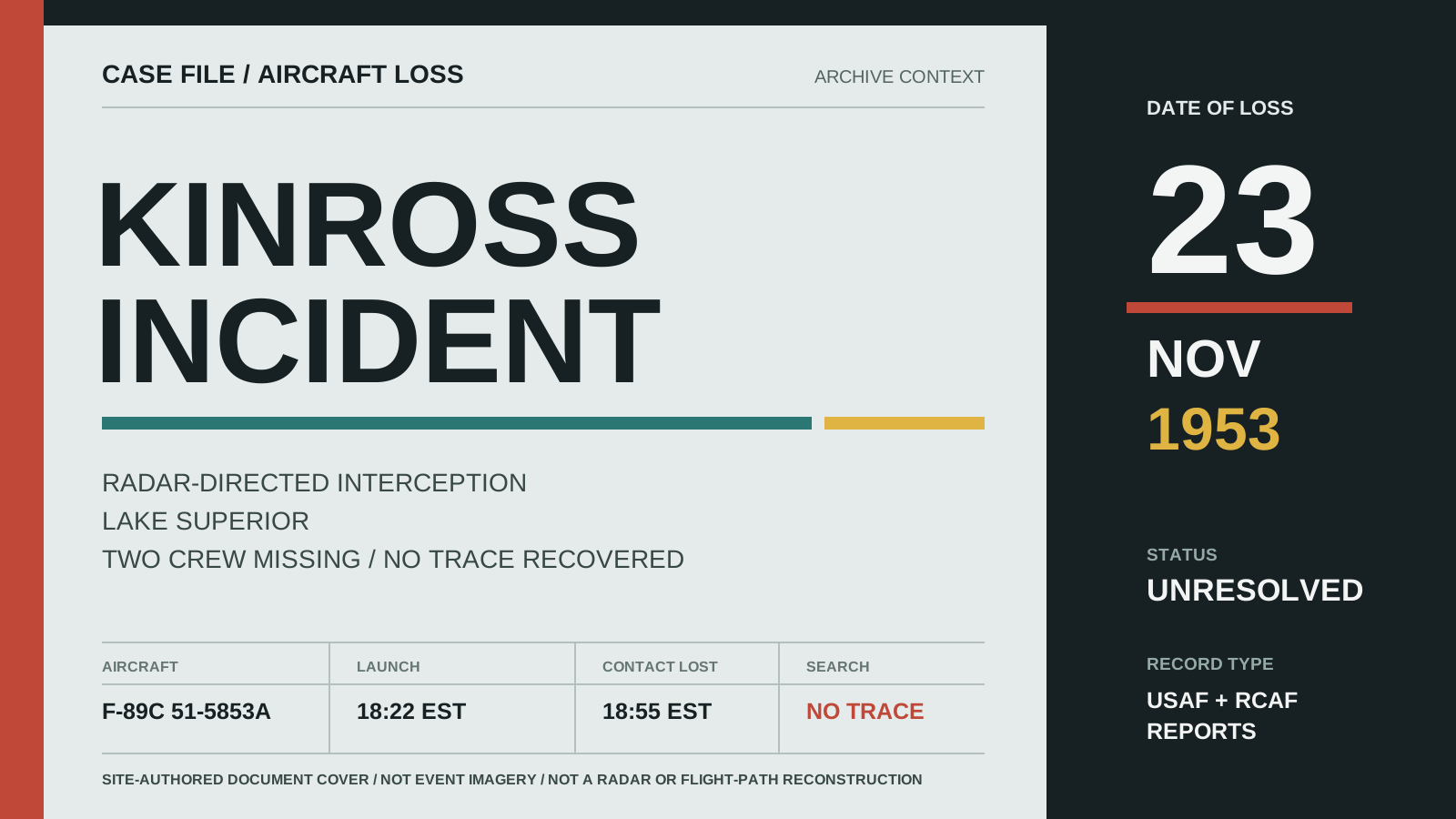
The displayed visual is a site-authored document cover. Its aircraft number, times, and search result summarize accepted official records. The line work is not a radar plot, flight-path reconstruction, event photograph, or depiction of the unknown target. The legacy Moncla portrait is not recommended because its reuse rights were not documented.