
United States / 1948 / EXPLAINED
1948 Mantell UFO Incident
On 7 January 1948, Kentucky Air National Guard pilot Captain Thomas F. Mantell Jr. died after climbing in a P-51 to investigate an object reported from Godman Field and other Kentucky locations. The surviving Project Blue Book file records tower observations and Mantell's radio descriptions of an object ahead and above him that appeared metallic and very large, but it contains no radar track, photograph or recovered object. Accident evidence and later Air Force analysis support loss of consciousness from oxygen deprivation followed by a high-speed dive and structural breakup; they do not show that the reported object attacked the aircraft. Venus was examined and did not adequately explain the daytime pursuit. Edward J. Ruppelt later judged a classified Skyhook-type high-altitude balloon the most coherent explanation for the visual reports. A balloon is the leading conventional assessment, but the public record does not conclusively identify one launch and track as the object Mantell followed.
This archive treats the case as explained or substantially resolved by conventional evidence.
- Documentation
- High documentation
- Primary location
- Godman Field and Franklin, Kentucky
- Source base
- 7 linked records
- Research use
- Comparison case
What the public record supports
- Confirmed event
- Godman personnel reported an aerial object, Mantell climbed to investigate it, and his P-51 crashed near Franklin on 7 January 1948.[2][4]
- Recorded description
- Typed Air Force summaries preserve reports of a large metallic-looking object ahead and above; no original radio audio survives in the public file.[2][3]
- Crash finding
- Hypoxia, loss of consciousness and a high-speed dive best explain the fatal crash; the wreckage record does not show an attack by the observed object.[2][3]
- Leading object explanation
- A Skyhook-type high-altitude balloon explains the visual pattern better than Venus, but no public launch-and-track record conclusively identifies the balloon.[3][5][6][7]
- Media boundary
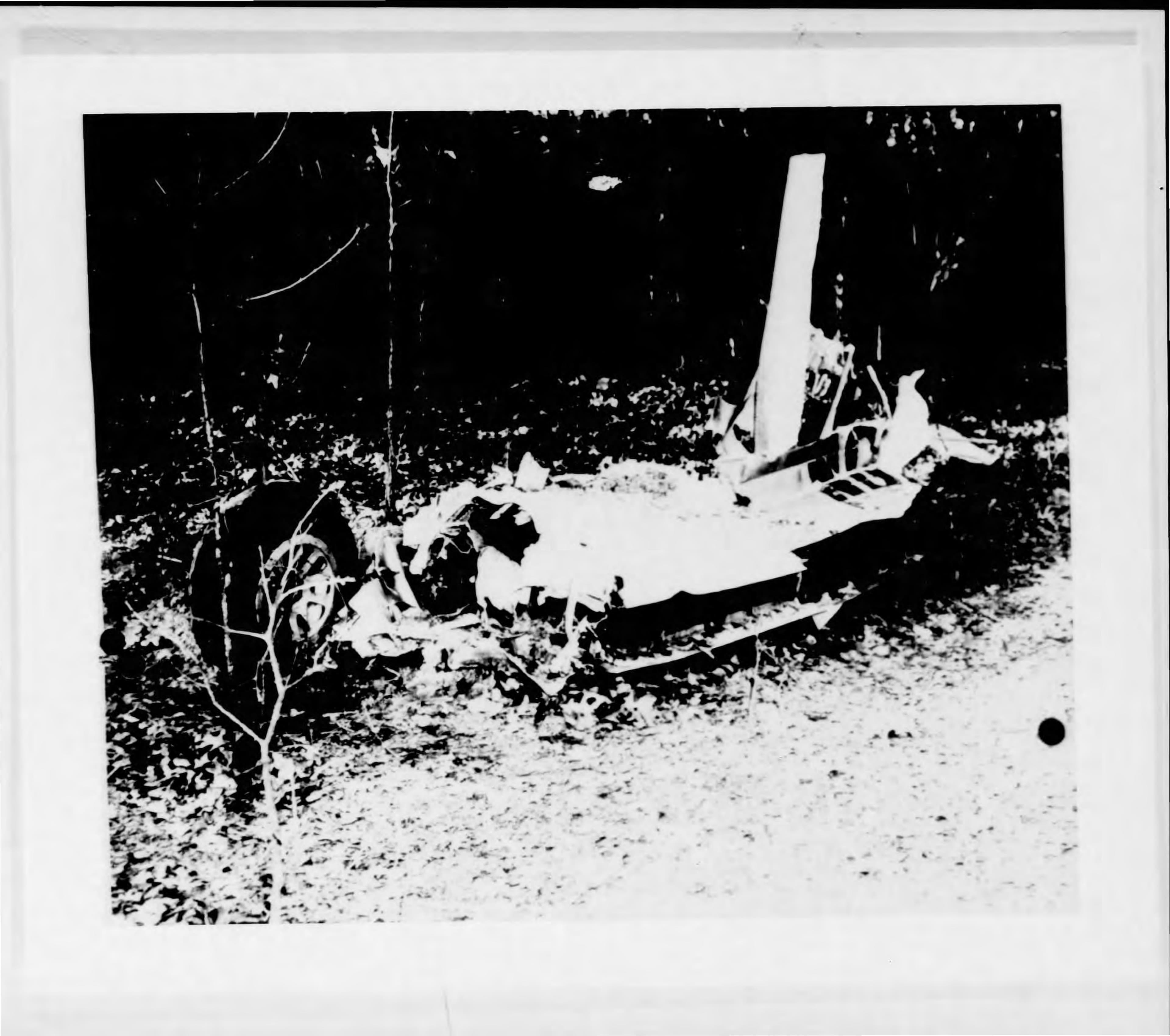
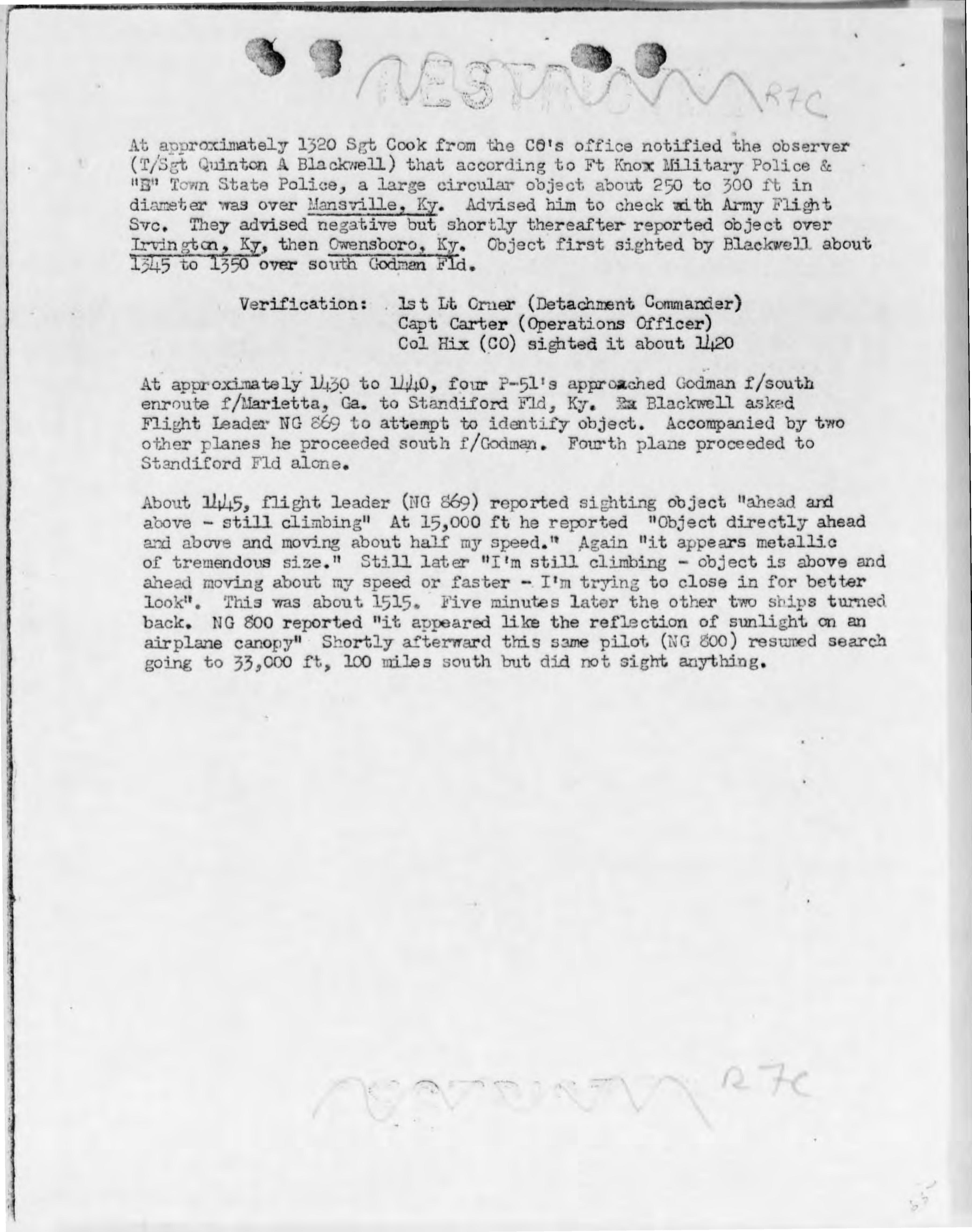
- The archive images show Mantell's crash wreckage and a typed chronology. No verified photograph or motion footage of the object is known in the reviewed record.[2]
Godman Field chronology
Case dossier
Reports reached Godman Field near Fort Knox during the early afternoon of 7 January 1948. A chronology preserved in the Air Force file says Sergeant Cook notified tower observer Technical Sergeant Quinton Blackwell at about 1:20 p.m. after calls from Fort Knox military police and Kentucky State Police. Reports placed a large round object over several Kentucky locations before Blackwell saw something south of Godman at roughly 1:45 to 1:50 p.m. Lieutenant Orner, Captain Gary Carter and Colonel Guy Hix also reported seeing it. Estimates of size and shape varied, and the file does not contain an instrument measurement that could convert those impressions into a verified distance or diameter.
The tower observations are important because they preceded Mantell's involvement, but they are still visual reports. Contemporary pages use descriptions such as circular, white, red below, parachute-like or cone-like. Those terms need not describe one stable geometry: a distant reflective balloon can change apparent shape with viewing angle, envelope folds and illumination. No surviving Godman radar plot is cited in the case file, and the observers lacked a known range. Claims that the object was hundreds of feet wide were therefore estimates, not measurements.
Between about 2: 30 and 2:40 p.m., four Kentucky Air National Guard P-51 Mustangs passed Godman while travelling from Marietta, Georgia, toward Standiford Field. Blackwell asked flight leader NG 869, flown by Mantell, to attempt an identification. Two aircraft joined him southward; a fourth continued to Standiford. The contemporaneous file calls the aircraft P-51s. Later retellings often use F-51, the designation adopted by the newly independent U.S. Air Force later in 1948. The distinction does not change the event, but it helps keep the chronology faithful to the records.
At about 2: 45 p.m., Mantell reported the object ahead and above while he climbed. At roughly 15,000 feet, the Godman chronology attributes to him the statements that it was moving at about half his speed and that it appeared metallic and of tremendous size. A later message said it remained above and ahead and that he was trying to close for a better look. Different pages and later retellings do not preserve one perfectly identical set of final words or times. The safe evidentiary claim is that the official file records a continuing climb and a large metallic-looking target; dramatic quotations beyond that should not be treated as exact transcripts.
The two accompanying pilots ended their climb and turned back. One later climbed again with oxygen and searched at high altitude without finding the object. Mantell did not return. His aircraft crashed near Franklin, Kentucky; photographs preserved in the Blue Book file show the wreckage and investigators recorded a broad debris field. These images document the fatal accident, not the aerial object. Mantell was an experienced Second World War pilot, and the Department of Veterans Affairs records his wartime transport service and decorations. Experience reduced neither the physiological risk of a high-altitude climb nor the need to distinguish an accident investigation from speculation about the target.
The crash sequence is better documented than the object's identity. Captain Carter's statement in the file says Mantell intended to climb to 20,000 feet and abandon the attempt if he could not get closer; Carter believed he blacked out from lack of oxygen. Ruppelt later wrote that the accident report described a high-speed descent and structural failure after loss of consciousness. That reconstruction is consistent with hypoxia and loss of control, although public copies do not provide a modern flight-data record. No official wreckage photograph or accident document in the reviewed file shows collision damage, weapon effects or material transferred from another craft.
Venus entered the official inquiry because it was above the horizon in the relevant part of the sky, and the Air Force requested an astronomical position calculation in October 1948. Ruppelt later rejected Venus as an adequate explanation for the main daytime observation: it would have been extremely difficult to see and could not account for the prolonged pursuit descriptions. Some reports of a bright object later that evening may have involved Venus, but those should not be merged automatically with the afternoon target. This is a useful boundary: the archive can reject an inadequate Venus explanation without treating every remaining claim as extraordinary.
Ruppelt's later high-altitude-balloon explanation fits several features better: changing apparent shapes, a reflective white object, slow drift that could seem to remain above a climbing fighter, and the fact that Skyhook balloons were then classified. Smithsonian histories confirm that the Skyhook program was operating by September 1947 and could reach about 30 kilometers. The unresolved part is provenance. Competing historical accounts disagree about which balloon, if any, crossed Kentucky on 7 January, and the public file does not supply a launch log and continuous track matching the sighting. The most careful conclusion is therefore two-part: a high-altitude balloon is the strongest explanation for the object, while hypoxia and loss of control best explain the fatal crash; the exact balloon identity remains unproven.
Timeline
- Godman Field receives police reports of a large aerial object over Kentucky and alerts tower observer Quinton Blackwell.
- Blackwell and other Godman personnel report seeing an object south of the field.
- Four Kentucky Air National Guard P-51s approach; Mantell and two wingmen are asked to investigate.
- Mantell reports the object ahead and above while climbing.
- The Godman chronology records Mantell still climbing and trying to close for a better look; the surviving pages vary on exact final wording.
- Mantell's P-51 crashes near Franklin, Kentucky; the Blue Book file preserves accident and wreckage records.
- Early Air Force case papers consolidate the tower chronology and initial investigation.
- The Air Force requests an astronomical calculation for Venus during the reported time window.
- Edward J. Ruppelt re-examines the case and favors a Skyhook-type high-altitude balloon over Venus.
- Project Blue Book closes and its case records later enter the National Archives; public copies preserve the Mantell file with gaps and inconsistent retellings.
Frequently asked questions
What happened in the Mantell UFO incident?
Kentucky Air National Guard pilot Thomas Mantell climbed in a P-51 to identify an object reported from Godman Field on 7 January 1948. He lost contact and crashed near Franklin.
What did Mantell report over the radio?
Typed summaries say the object was ahead and above, appeared metallic and very large, and remained above him as he climbed. Exact final wording varies, and no original audio is public.
Why did Thomas Mantell crash?
The strongest accident reconstruction is oxygen deprivation followed by loss of consciousness, a high-speed dive and structural breakup. The record does not show a collision or attack.
Was the object Venus?
Venus was examined because it was in the relevant sky, but later Air Force analysis found it too difficult to see by day and unable to explain the pursuit. It may explain separate evening reports.
Was it a Skyhook balloon?
A Skyhook-type high-altitude balloon is the leading conventional explanation and the program was active at the time. The public file does not identify one specific launch and continuous track conclusively.
Are there photographs or video of the object?
No verified event photograph or motion footage of the object is known in the reviewed public record. The images shown here are official crash and document scans, not object imagery.
Why is the Mantell incident important to UFO history?
It was an early, fatal military interception case that influenced public debate and Air Force handling of UFO reports. Its records also show how secrecy, uncertain range and aviation risk complicate identification.
Sources
- [1] Official fileProject Blue Book records at the National ArchivesU.S. National Archives and Records Administration
- [2] ArchiveProject Blue Book: complete Thomas Mantell case fileU.S. Air Force / NARA scan via The Black Vault
- [3] ArchiveThe Report on Unidentified Flying Objects, Chapter 3Edward J. Ruppelt / Wikisource
- [4] Official fileVeteran of the Day: Air Corps Veteran Thomas Mantell Jr.U.S. Department of Veterans Affairs
- [5] ResearchTracking the Elusive Radiosonde: Skyhook balloon historySmithsonian Institution Scholarly Press
- [6] Reference databaseSkyhook, Helios and Strato-Lab balloon collectionSmithsonian National Air and Space Museum Archives
- [7] ResearchThe Mantell Incident: The Story RevisitedNICAP archive
The main image is a public-domain U.S. Air Force case-file photograph of Mantell's crash wreckage. The supplementary image is the typed Godman Field chronology that records tower and radio reports. Both document the investigation; neither is a photograph of the reported aerial object. No reliable event video was found, so none is embedded.