
United States / 1948 / UNRESOLVED
Chiles-Whitted UFO encounter
At about 02:45, recorded in the contemporary file as Eastern Standard Time, on 24 July 1948, Eastern Air Lines Trip 576 was flying at 5,000 feet roughly 20-25 miles southwest of Montgomery, Alabama. Captain Clarence S. Chiles and co-pilot John B. Whitted reported a wingless, cigar-like form with bright openings, a blue glow below and a long red-orange exhaust-like flame; their signed accounts and drawings differ on distance, duration and details. Passenger McKelvie saw only a momentary straight streak of red and yellow light and no physical shape. Project Sign checked military traffic and 225 commercial or government schedules without finding a fit, and the archival case was retained as an unknown. Project Grudge's later astronomical review considered a brilliant meteor a fair or low-probability explanation, not a demonstrated solution. No photograph, radar return, physical trace or measured size survives. The alleged 1948 Estimate of the Situation is known through later recollection, but AARO reported that it could not locate or verify the document. The visual report therefore remains unresolved; that does not establish an extraterrestrial craft.
This case remains unresolved in the public record, with credibility grade B.
- Documentation
- High documentation
- Primary location
- Approximately 20-25 miles southwest of Montgomery, Alabama
- Source base
- 5 linked records
- Research use
- Comparison case
What the 1948 record establishes
- Flight record
- Eastern Air Lines Trip 576 was at 5,000 feet roughly 20-25 miles southwest of Montgomery at about 02:45, recorded as EST. The file does not support a precise UTC conversion or surveyed encounter point.[1]
- Pilot accounts
- Chiles and Whitted agreed on a wingless luminous form, openings, rear flame, right-side passage and no turbulence. Their estimates and drawings differ on range, duration, openings, nose and cockpit details.[1]
- Passenger limit
- McKelvie independently saw a brief straight red-yellow light streak moving southeast, but no physical body. He does not corroborate the pilots' cigar shape, windows, speed, distance or climb.[1]
Case dossier
The strongest event coordinates are descriptive rather than surveyed. Chiles placed Trip 576 about 20 miles southwest of Montgomery; Whitted wrote 25 miles southwest, with the DC-3 on a compass heading of 50 degrees and the object moving oppositely. Whitted also wrote that the trip had left Houston at 20:40 and later bypassed fog-covered Columbus before continuing to Atlanta. The same line calls the departure “Friday night, July 22,” although 22 July 1948 was a Thursday and the encounter file is dated 24 July. The archive therefore preserves that date conflict and the clock label “EST” without inventing a UTC conversion or a precise plotted point.
Chiles's signed statement says a jet-like object approached from the right and slightly above in clear moonlight. During roughly ten seconds he saw no wings, described two rows of windows or openings lit from within, a blue glow beneath the body and a power-exhaust-like flame extending about 50 feet. He said it passed on the right, pulled sharply into light broken cloud and vanished, with no prop wash or rough air. A later investigative summary adds his impression of a cockpit and radar-like “snout”; those features are attributed to Chiles in that later summary, not treated as shared observations or instrument detection.
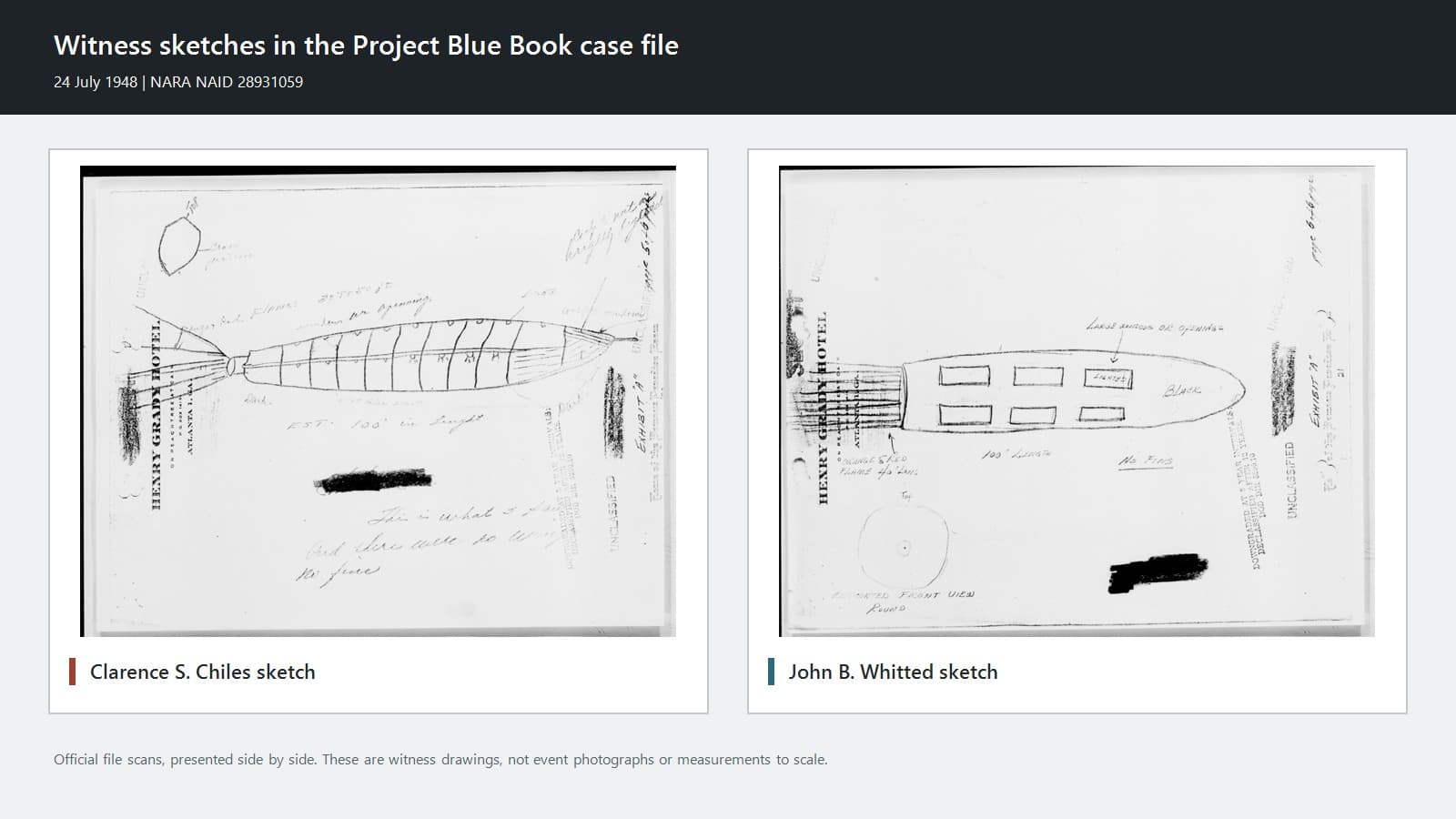
Whitted's signed account estimates a cigar-like body about 100 feet long, roughly three times the circumference of a B-29 fuselage, with two rows of very large square windows and white light he interpreted as combustion. He estimated about half a mile separation, roughly 700 mph and five to ten seconds of viewing, but none was instrumentally measured. His drawing shows six rectangular openings and a dark nose; Chiles's drawing uses a longer sequence of openings and a circular end view. Whitted did not report Chiles's cockpit or snout. Both agreed on no wings, a red-orange rear flame, straight and level passage, no sound heard and no turbulence.
The passenger evidence is narrower. Major P. A. Llewellyn's 31 July interview memorandum summarizes McKelvie's written statement: from a right-side seat he saw a sudden light streak crossing the airway toward the southeast, briefly lost it while shifting position, then saw it again. He described a bright, probably light-cherry-red flame with yellow edges moving in a straight line. He saw no physical shape and heard no sound, while noting that aircraft vibration would have made outside sound difficult to hear. This independently supports a brief luminous passage, not the pilots' cigar body, windows, distance, speed or upward turn.
Project Sign personnel interviewed the pilots on 25 July, obtained signed statements and drawings, and interviewed McKelvie on 31 July. Investigators requested air-movement data across Alabama, Florida, Mississippi, Georgia, South Carolina, Tennessee and North Carolina. A later report says 225 commercial and government schedules were checked; a C-47 candidate failed the time, speed, direction, maneuver and color tests. Calls to Columbus and Lawson Field also produced no matching jet. This eliminates the specific traffic checked, not every possible aircraft, meteor or perception effect.
The 20 December 1948 Air Intelligence Information Report combined this event with other reports from 24 and 26 July and judged the Chiles-Whitted incident significant, not identified as a meteor and still unidentified. Its “flying fuselage,” propulsion and RAND discussions are intelligence speculation, not observations made from the DC-3. Other bundled reports include apparent fireballs and cannot be counted as sightings of the same object. An undated archival classification sheet later calls incident 144 a true “Unknown.” That administrative label records the file outcome; it does not certify the object's shape, performance or origin.
Timeline
- At 5,000 feet roughly 20-25 miles southwest of Montgomery, Chiles and Whitted saw a luminous, flame-tailed form pass the right side of Eastern Air Lines Trip 576. Their records give about 5-15 seconds depending on the statement or later summary.
- The crew radioed the company at Columbus and asked about Army jets or experimental aircraft near Lawson Field. No matching traffic was reported; ground fog led the flight to bypass Columbus and continue to Atlanta.
- Project Sign officer Major P. A. Llewellyn and other personnel interviewed the pilots. Their signed statements and separate drawings entered the Air Force file.
- Llewellyn interviewed passenger McKelvie and summarized his written statement. McKelvie reported only a straight red-yellow flame streak moving southeast, with no visible body.
- Air Intelligence Information Report 102-122-79 summarized schedule checks, separated the incident from meteor identifications in nearby reports and retained it as unidentified while adding speculative intelligence analysis.
- Project Grudge's astronomical evaluation placed incident 144 in the “fair or low probability” group and tested a brilliant meteor explanation, including the possibility that perceived windows were subjective.
- Edward J. Ruppelt's 1956 memoir linked the encounter to an interplanetary Estimate of the Situation, but also introduced details that conflict with the signed accounts. AARO's 2024 history said it could not verify the claim or locate the alleged estimate.
Questions about the Chiles-Whitted encounter
What happened in the Chiles-Whitted encounter?
At about 02:45 on 24 July 1948, two Eastern Air Lines pilots at 5,000 feet near Montgomery reported a wingless luminous form passing on their right and climbing into cloud. Their brief visual estimates were recorded by Project Sign; the object was not identified.
What did passenger McKelvie actually see?
He reported a momentary straight streak of light moving southeast, probably light cherry red with yellow edges. He explicitly saw no physical shape. His account supports a luminous passage but not the pilots' detailed body description.
Did Chiles and Whitted give identical accounts?
No. They agreed on the main luminous, wingless, flame-tailed appearance and no turbulence, but differed on viewing duration, estimated separation and sketch details. A cockpit and radar-like nose appear only in a later summary of Chiles's impressions.
Was the object a meteor?
A brilliant slow meteor is plausible and fits McKelvie's streak plus several light and duration features. Project Grudge rated the astronomical explanation only fair or low probability because the pilots described structure and a climb. The surviving data cannot prove or exclude it.
Did the Estimate of the Situation prove an interplanetary origin?
No surviving document establishes that. Ruppelt's 1956 memoir says a Top Secret estimate reached that conclusion and was rejected, but AARO reported in 2024 that it could not verify the claim or locate the document. It is a later historical claim, not recoverable 1948 evidence.
Are there photographs, radar records or original video?
No authenticated event image, radar target record or original event film is public. The displayed image is an editorial composite of the pilots' archival sketches. The old saucer image is a separate 1964 NASA record and is not evidence from this encounter.
Sources
- [1] Official fileProject Blue Book case file: Chiles-Whitted incident, July 1948U.S. National Archives and Records Administration
- [2] Official fileProject Grudge technical report and astronomical evaluations, August 1949U.S. Air Force / U.S. National Archives and Records Administration
- [3] Official fileAARO Historical Record Report, Volume 1All-domain Anomaly Resolution Office / U.S. National Archives
- [4] ArchiveEdward J. Ruppelt's 1956 memoir, The Report on Unidentified Flying ObjectsProject Gutenberg
- [5] Official fileNational Archives guide to Project Blue Book recordsU.S. National Archives and Records Administration
The displayed image is a site-authored composite of Chiles's and Whitted's archival witness sketches, not an event photograph, scale drawing or measured reconstruction. No authenticated event photograph, radar image or original event video was found. The legacy saucer PNG is an unrelated 1964 NASA catalog item and is excluded from active media.