
United States / 1948 / DISPUTED
Gorman dogfight
On 1 October 1948, George Gorman reported a 27-minute F-51 pursuit of a small white light over Fargo. Three other witnesses briefly saw a white light, but did not corroborate the full complex chase. Project Sign first treated Gorman as sincere and temporarily rejected ordinary aircraft and the known balloon; a January 1949 Air Weather Service reconstruction later found that the lighted weather balloon could have occupied the reported area. The file has no photograph, radar return, physical craft or meaningful radiation anomaly. Balloon motion and perceptual effects provide a substantial conventional account, while gaps in continuous tracking prevent a fully demonstrated reconstruction.
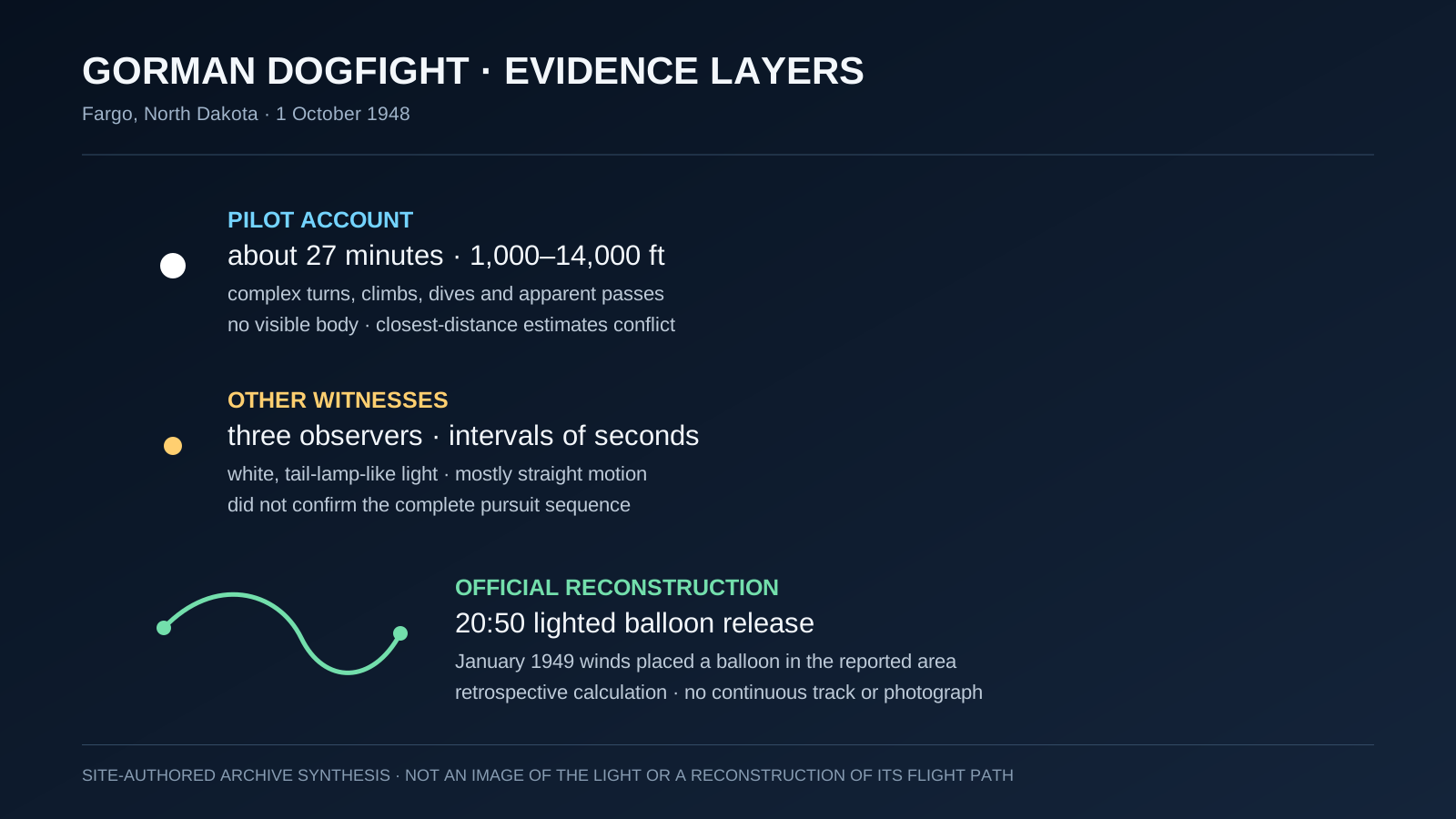
This case is disputed. The archive preserves the claims while separating evidence from interpretation.
- Documentation
- High documentation
- Primary location
- Fargo, North Dakota
- Source base
- 6 linked records
- Research use
- Comparison case
What the record establishes
- Pilot report
- Gorman reported about 27 minutes of complex pursuit; his closest-distance estimates conflict.[1]
- Other witnesses
- Three people saw a white light for seconds, not the complete dogfight narrative.[1]
- Balloon record
- A lighted balloon was released about ten minutes earlier; a later wind reconstruction placed it in the area.[1]
- Instrumentation
- No photograph or radar track exists, and the radiation readings were not anomalous.[1]
Observation layers
Case dossier
On the evening of 1 October 1948, North Dakota Air National Guard pilot George F. Gorman was flying an F-51 near Fargo after other aircraft had landed. He reported pursuing a small, sharply bounded white light for about 27 minutes, from roughly 1,000 to 14,000 feet. He described turns, climbs, dives and apparent passes at his fighter. He saw no wings, fuselage, exhaust or other structure, and heard no sound. His estimates varied within the file: a checklist gave a closest distance of 1,000 yards, a signed statement described about 500 yards, and a later summary said less than 500 feet.
The event had additional witnesses, but their evidence was narrower than the later phrase 'dogfight' suggests. Airport controllers Lloyd D. Jensen and Manuel E. Johnson, and physician-pilot A. E. Cannon after landing his Piper Cub, saw a white light for intervals of only several seconds. Their forms compare it to a tail lamp and mostly describe straight motion; Jensen and Cannon each reported one turn or relative maneuver. None documented Gorman's full sequence, an object body, sound, exhaust or a 27-minute engagement.
Project Sign investigators arrived on 3 October and treated Gorman as sincere. Their report corrected press-like descriptions of a 'disc': witnesses had reported an intermittent circular white light, not a visible physical form. Investigators checked aircraft, Canadian Vampire jets and local balloon releases. Those possibilities were initially marked discredited, and the file said Gorman's account should be accepted as truthful until shown inaccurate. That was a witness assessment and an interim investigative posture—not a finding of an extraterrestrial vehicle.
The balloon question changed as the inquiry continued. A field report recorded that Fargo weather staff had released a lighted balloon about ten minutes before Gorman's first call and reportedly watched it drift slowly west at about 500 feet, treating it as separate from the faster light. On 24 January 1949, however, the Air Weather Service used release time and winds aloft to conclude that a synoptic balloon could have occupied the reported area. The surviving plot is a retrospective possibility calculation, not a photographed match or continuous tracking record.
Other tests added little. Gorman's aircraft produced Geiger-counter readings, but the technical report said a definite excess would have needed readings roughly 30 to 40 times larger; five comparable aircraft served as controls. No photograph, radar return or recovered material exists in the file. An engineering note explored acceleration from Gorman's sketched path but warned that assumptions about the curve and other untreated factors controlled the result.
The archive supports a real report and a conventional candidate, but not a single fully demonstrated reconstruction. A lighted balloon can account for a small white light and much of the brief ground evidence; pursuit geometry, distance error and autokinesis can magnify apparent motion when a pilot maneuvers around a point light at night. Later authors also proposed that Gorman switched attention from the balloon to Jupiter or its optical distortion. That two-target model is a later hypothesis, not a contemporary observation. The responsible disposition is disputed: the case does not establish an exotic craft, while the public file does not continuously identify one object through every reported maneuver.
Timeline
- A lighted weather balloon was released at Fargo.
- Gorman began reporting and pursuing the white light.
- Jensen, Johnson and Cannon briefly observed a white light.
- Project Sign investigators interviewed witnesses at Fargo.
- Gorman signed a detailed statement with a roughly 500-yard closest approach.
- The Air Weather Service reported that the balloon could have reached the sighting area.
- A Project Saucer press memorandum recounted the case without a case-specific final disposition.
Questions about the Gorman case
Was there really a dogfight?
'Dogfight' is a media shorthand. Gorman reported pursuit and apparent passes, but no weapons were fired and other witnesses did not see the full sequence.
What did the other witnesses see?
They briefly saw a white, tail-lamp-like light, mostly moving straight. They did not report a visible craft body.
Did Project Sign call it extraterrestrial?
No. Investigators considered Gorman sincere and kept technical questions open; that is not an extraterrestrial finding.
Was a weather balloon present?
Yes. A lighted balloon was released shortly before the sighting. Whether Gorman watched only that balloon through every reported maneuver is not continuously documented.
Was the aircraft radioactive?
No meaningful anomaly was established. The technical review said a definite excess would have required readings 30 to 40 times larger.
Why classify the case as disputed?
The balloon and perceptual model explains important evidence, but the archive does not document a single target continuously enough to call the complete report reconstructed.
Sources
- [1] Official fileGorman NARA microfilm case fileAmerican Heritage Center, University of Wyoming
- [2] Official fileProject Blue Book recordsU.S. National Archives
- [3] ArchiveProject Saucer memorandum to the pressNational Military Establishment
- [4] Official fileProject Grudge documentsU.S. Air Force
- [5] ArchiveThe World of Flying SaucersProject Gutenberg
- [6] News reportThe WWII pilot who chased a UFO over FargoHISTORY
The visual is a site-authored evidence comparison, not event imagery or a claimed flight path. No authenticated photograph or film of the light was found.